 Your PC in instalments (up to 12x)
By the FlowUP team, gaming PC builder in Genappe (Belgium) · Updated 30 September 2026
In brief: on 18 September 2025, NVIDIA and Intel announced a partnership: NVIDIA will invest $5 billion in Intel, and the two groups will jointly develop x86 processors for PCs integrating an RTX graphics chip (the “Intel x86 RTX SoC”), as well as custom x86 processors for NVIDIA data centres. The investment was finalised after the FTC gave its approval in December 2025. No release date has been announced for the first chips.
From 2023 to 2025: how we got here
In May 2023, Jensen Huang, the head of NVIDIA, said that tests of a chip made using Intel’s manufacturing process looked promising. At the time, the question was whether Intel, which had just opened its fabs to other companies, would one day manufacture NVIDIA chips.
Two years later, the rapprochement took a completely different form. On 18 September 2025, the two companies announced a far broader deal: NVIDIA’s investment in Intel’s equity and the joint development of processors, for both PCs and servers.
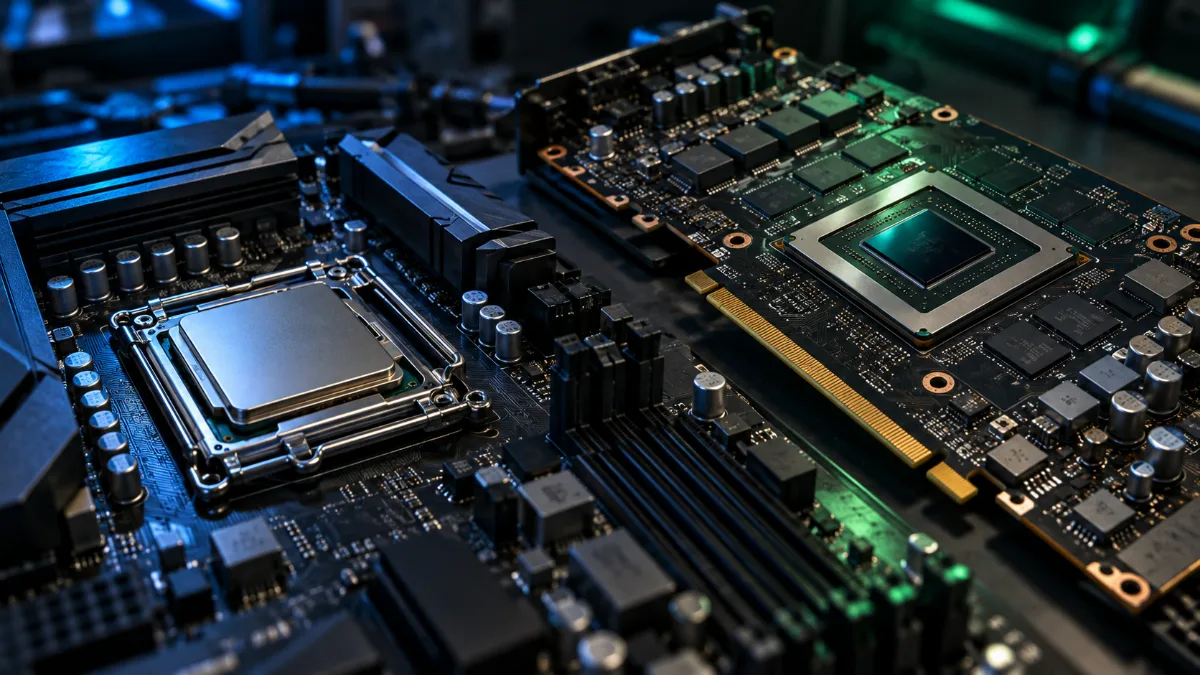
x86 processor and RTX graphics chip together: that’s the core of the NVIDIA and Intel partnership.
What the deal covers
| Key point | Detail |
|---|---|
| Announcement | 18 September 2025 |
| Investment | $5 billion: NVIDIA buys around 214.7 million Intel shares at $23.28 |
| Green light | US FTC approval in December 2025 |
| For PCs | Intel x86 processors integrating an NVIDIA RTX graphics chip, the “Intel x86 RTX SoC” |
| For servers | Custom x86 processors made by Intel for NVIDIA’s AI platforms |
| Date of the first products | Not announced |
Sources: Tom’s Hardware (September and December 2025).
What does this change for gamers?
In the short term, nothing: no chip from the partnership has been released yet, and 2026 gaming PCs still pair a separate processor with a separate graphics card. In the longer run, the “Intel x86 RTX SoC” are mainly aimed at laptops and compact machines: an Intel processor with, in the same chip, an RTX graphics block far more powerful than today’s integrated chips, with DLSS. Enough to make gaming more accessible on a thin laptop.
Our assembler’s take: for a desktop gaming PC, a dedicated graphics card remains essential. An integrated chip, even an RTX, won’t compete with an RTX 5070 Ti and its 300 W of power draw. The partnership is mainly good news for laptops and for competition versus AMD chips that combine a powerful processor and graphics. To choose your platform today, read our comparison Intel or AMD for gaming.
Intel and NVIDIA in our PCs today
While we wait for the shared chips, the Intel-and-NVIDIA duo remains a classic in our configurations:
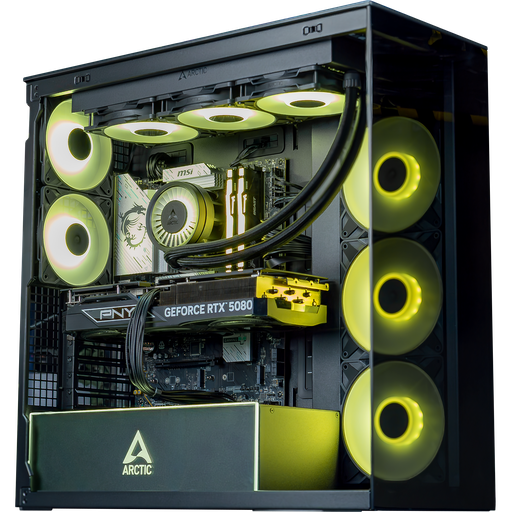
Arctic PC: Core Ultra 7 and RTX 5080
Core Ultra 7 265KF, RTX 5080 16 GB and 32 GB of DDR5: Intel and NVIDIA’s high-end for 4K.
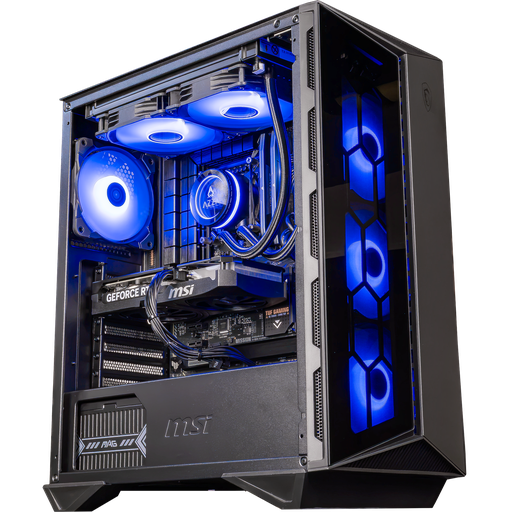
Swift PC: Core i5 and RTX 5060 Ti
Core i5 14400F, RTX 5060 Ti 16 GB and DDR5: the Intel and NVIDIA duo for 1080p and 1440p.
FAQ: the NVIDIA and Intel partnership
When did NVIDIA and Intel announce their partnership?
On 18 September 2025, with NVIDIA’s $5 billion investment in Intel.
What is an “Intel x86 RTX SoC”?
An Intel x86 processor for PCs that integrates, in the same chip, an NVIDIA RTX graphics section. It is mainly aimed at laptops and compact PCs.
When will the first Intel chips with RTX graphics be released?
No date has been announced by NVIDIA or Intel in September 2026.
Did NVIDIA buy Intel?
No. NVIDIA has taken an equity stake of around $5 billion in Intel, which remains an independent company.
Should you wait for these chips to buy a gaming PC?
No. They are mainly aimed at laptops, and for a desktop PC a dedicated graphics card remains far more powerful.
Sources
- Tom’s Hardware, announcement of the NVIDIA and Intel partnership (September 2025)
- Tom's Hardware, investment finalised after FTC approval
