
By the FlowUP team, gaming PC builder in Genappe (Belgium) · Updated 30 September 2026
In brief: the Radeon RX 8800 XT was never released under this name. The RDNA 4 card that rumours in 2024 called it is the one that arrived on the 6 March 2025 under the name Radeon RX 9070 XT ($599 at launch in the US), alongside an RX 9070 ($549). And the rumour was spot on in one respect: according to Tom's Hardware, the RX 9070 XT matches the RTX 4080.
Why AMD didn’t release an RX 8800 XT
In late 2024, everyone was talking about the RX 8800 XT: it was the logical name to succeed the RX 7800 XT and 7900. At the January 2025 CES, AMD changed course and skipped the 8000 series for its desktop cards. The new lineup is called RX 9000, with numbering patterned after NVIDIA’s: the RX 9070 XT targets the RTX 5070 Ti, and the RX 9070 targets the RTX 5070.
The “8000” name hasn’t disappeared, though: it refers to the integrated graphics chips on some laptop CPUs, such as the Radeon 8060S. So if you’re looking for a “RX 8800 XT” in a shop, you’ll actually need an RX 9070 XT. The full story of the range is in our article why there isn’t a Radeon RX 8000.
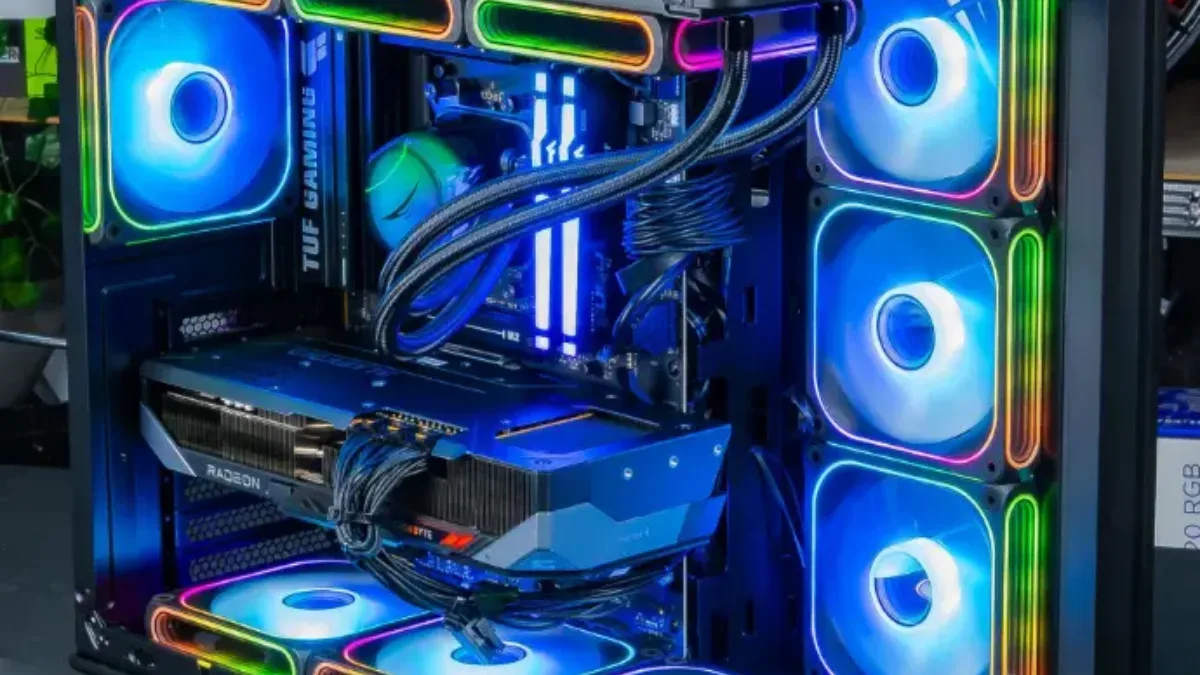
The expected card, under the name RX 8800 XT, is now powering our PCs under the name RX 9070 XT.
RX 9070 XT: the “RX 8800 XT” specifications
| Specification | Radeon RX 9070 XT | Radeon RX 9070 |
|---|---|---|
| Architecture | RDNA 4 | RDNA 4 |
| Compute units | 64 | 56 |
| Memory | 16 GB GDDR6, 256-bit | 16 GB GDDR6, 256-bit |
| Power consumption (TBP) | 304 W | 220 W |
| Upscaling | FSR 4 | FSR 4 |
| Release | 6 March 2025 | 6 March 2025 |
| Launch price (US) | $599 | $549 |
Sources: AMD and GamersNexus, consulted on 30 September 2026.
RX 9070 XT vs RTX 4080: the rumour was right
The 2024 leaks promised an AMD card on par with an RTX 4080 in rasterisation. That’s what you see in Tom’s Hardware’s ranking: the RX 9070 XT is within less than 3% of the RTX 4080 at all resolutions, and also on par with the RTX 5070 Ti.
| Graphics card | 1080p ultra | 1440p ultra | 4K ultra |
|---|---|---|---|
| Radeon RX 7900 XTX | 161.5 FPS | 122.3 FPS | 70.6 FPS |
| GeForce RTX 4080 Super | 158.9 FPS | 118.6 FPS | 69.4 FPS |
| GeForce RTX 4080 | 157.3 FPS | 117.5 FPS | 67.5 FPS |
| Radeon RX 9070 XT | 156.6 FPS | 116.5 FPS | 65.8 FPS |
| GeForce RTX 5070 Ti | 155.4 FPS | 116.8 FPS | 68.6 FPS |
| Radeon RX 9070 | 140.9 FPS | 104.0 FPS | 57.7 FPS |
| GeForce RTX 5070 | 132.6 FPS | 96.4 FPS | 54.3 FPS |
Source: Tom’s Hardware, GPU rankings (average of 11 games in rasterisation, Ryzen 7 9800X3D), updated 24 June 2026.
Our builder’s verdict: the RX 9070 XT is one of the most interesting cards around for 1440p. It delivers RTX 4080-level performance in rasterisation, 16 GB of video memory, and FSR 4, which has finally caught up on a good part of its delay versus DLSS. In heavy ray tracing and path tracing, NVIDIA still has the edge: if that’s your priority, the RTX 5070 Ti remains the benchmark.
For the full showdown, read RX 9070 and RX 9070 XT and RTX 5070 vs RX 9070.
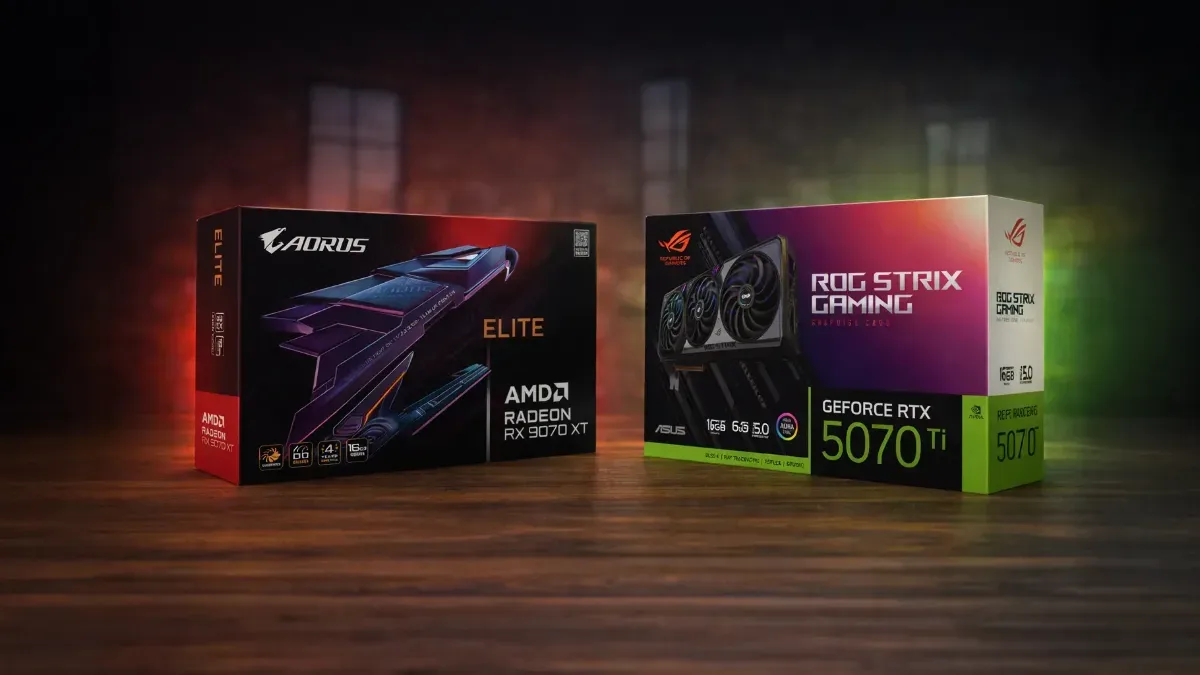
RX 9070 XT or RTX 5070 Ti: two cards neck and neck in rasterisation.
Our PCs with a Radeon RX 9070 XT
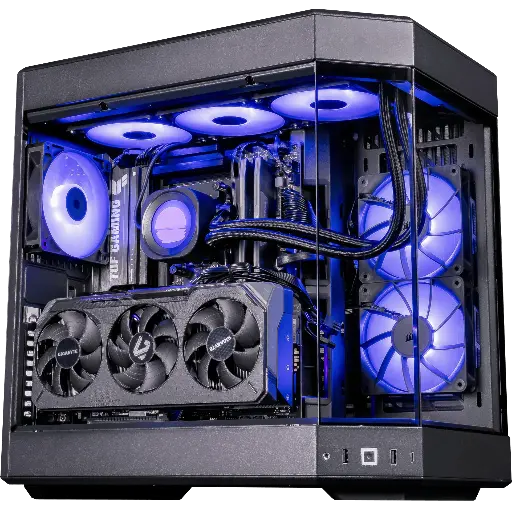
Shadow V2 PC: RX 9070 XT
Radeon RX 9070 XT 16 GB and Ryzen 7 9800X3D: high-frequency 1440p and 4K with upscaling.
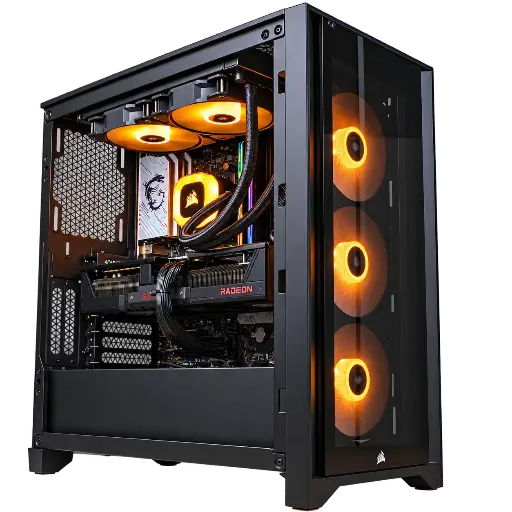
Prism PC: RX 9070 XT 16 GB
The RX 9070 XT and its 16 GB of video memory for playing at 1440p with high settings.
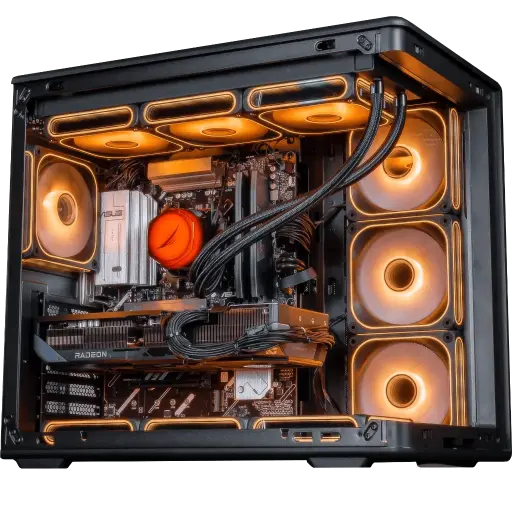
Apex V2 PC: RX 9070 XT 16 GB
Another configuration around the RX 9070 XT 16 GB, for 1440p and 4K with FSR 4.
FAQ: Radeon RX 8800 XT
Does the Radeon RX 8800 XT exist?
No. The card expected under this name was released as the Radeon RX 9070 XT.
What is the release date of the RX 8800 XT?
Under its real name, the RX 9070 XT, it was released on 6 March 2025.
Is the RX 9070 XT as powerful as an RTX 4080?
In rasterisation, yes: according to Tom’s Hardware, it’s within less than 3% of the RTX 4080 at 1080p, 1440p and 4K. In heavy ray tracing, the RTX 4080 still comes out ahead.
How much video memory does the RX 9070 XT have?
16 GB of GDDR6 on a 256-bit bus, like the RX 9070.
Will there be a Radeon RX 8000 for desktop PCs?
Nothing indicates it. AMD moved directly from the RX 7000 series to the RX 9000 series for its desktop cards.
