Your PC in instalments (up to 12x)
Choosing between a desktop PC and a laptop is no longer just a matter of simple aesthetic preference or portability.
In 2026, both formats have evolved, with major differences in terms of performance, cooling, upgradability, gaming / creative experience, price and mobility.
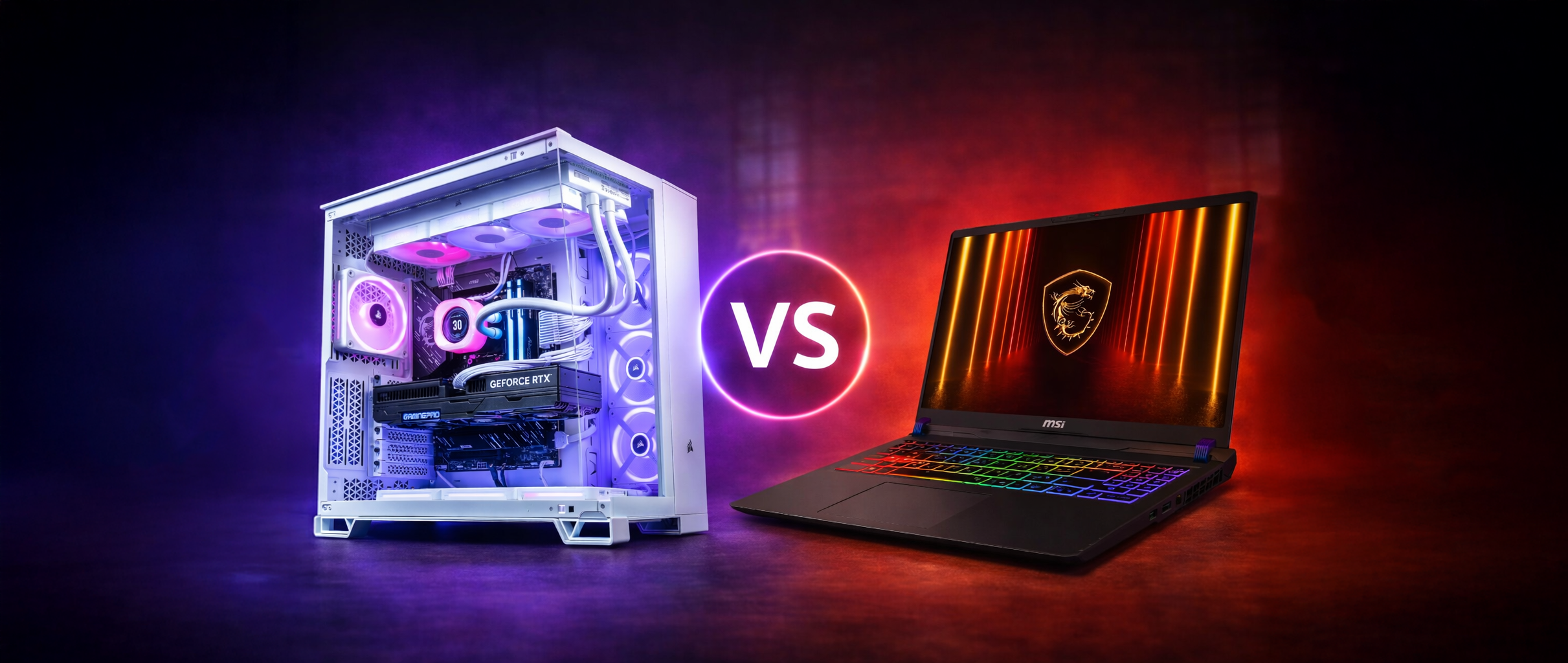
This guide gives you the right criteria to make the right choice based on your actual use.
Raw performance: desktop PC wins
The desktop PC generally offers more power for the same budget.
The reason is simple:
- Better cooling
- Larger and more efficient components (5090 desktop > 5090 laptop)
- More robust power supply
- Fewer thermal constraints
That translates into higher performance for gaming, content creation, 3D rendering or heavy video editing. High-end GPUs and CPUs can really perform without being held back.
Portability and accessibility: the laptop’s advantage
A laptop is unbeatable if you need:
- mobility (studies, work, LANs, trips),
- an all-in-one ready to use,
- a complete setup without extra peripherals.
You can stream, play or create from anywhere. Recent laptops can even deliver very high performance, especially with the latest generations of mobile CPUs and GPUs.
Cooling and noise: the desktop dictates the rules
A key point in 2026 is thermal management.
Desktop PCs:
- benefit from larger cases,
- have more space for AIO coolers / watercooling,
- and can stay quiet even under load.
A powerful laptop, on the other hand, often has to run its fans at full speed under load, which can be noisy and hot.
Upgradability: the desktop PC’s biggest argument
A desktop PC offers unmatched upgradability:
- you can easily swap the GPU, CPU, RAM and storage,
- add a better cooling system,
- upgrade certain parts without replacing the whole machine.
Even a high-end laptop is highly limited:
some changes are impossible, and they’re often expensive (or not recommended).
Price / performance: often better with a desktop
With the same budget, the desktop PC will generally offer:
- a more powerful CPU,
- a bigger GPU,
- higher overall power.
Laptops often lose out on performance per pound because of miniaturisation and manufacturing cost.
Gaming: laptop is OK, but desktop wins long-term
2026 brings highly capable gaming laptops (mobile RTX, 240 Hz screens, etc.), but:
- Desktop PCs maintain superior performance,
- They run cooler,
- They’re quieter at the same load,
- They’re easier to keep going over time.
👉 Conclusion: the laptop is perfect if you game everywhere and you’re willing to accept a few compromises. The desktop is better for a pure, long-lasting experience.
Content creation: desktop preferred
For content creation (video editing, 3D, DAW, animation...) :
- the desktop PC handles heavy tasks better (renders, exports),
- it can take more RAM and storage,
- it runs cooler during long sessions.
Creative laptops are good for getting started or for mobility, but professionals prefer the desktop. If your only option is to buy a laptop, then go for the latest MACs equipped with M4 chips.
Battery, mobility & everyday use
A laptop remains second to none for mobility:
- built-in battery,
- everything included,
- no accessories needed.
But battery life is always limited depending on the load, and mobile performance often drops in "on battery" mode.
Screen / audio / peripherals experience
With a desktop PC, you choose:
- the right monitor(s) (ultrawide, 4K, high Hz),
- custom keyboard / mouse,
- an external audio system.
With a laptop, you often depend on built-in components, even though you can still add peripherals.
What’s the verdict?
- Nomadic & versatile → laptop
- Intensive gaming & upgradability → desktop PC
- Professional creation & heavy renders → desktop PC
- Pro creation & on the move → MAC
- Beginner / student → Laptop if your budget is limited
- Desk setup + light mobility → MAC or laptop PC