 Your PC in instalments (up to 12x)
By the FlowUP team, gaming PC assembler in Genappe (Belgium) · Updated 28 September 2026
For a good brand-new gaming PC built in 2026, budget between €1,000 and €1,500 to play comfortably in Full HD, around €2,000 for 1440p on ultra settings, and €3,000 or more for 4K. The right budget mainly depends on three things: the resolution of your screen, the games you play, and the number of frames per second you’re aiming for. Here’s how to work it out without paying for unnecessary performance, or ending up bottlenecked in six months.
In short
- Under €1,000: esports games in Full HD (Fortnite, Valorant, League of Legends), newer games on medium settings.
- €1,000 to €1,900: all games in Full HD, and 1440p on high settings at the top end of the range.
- €1,900 to €2,900: 1440p in ultra with a high-refresh-rate monitor, 4K within reach.
- €3,000 and up: 4K in ultra, heavy creation work.
- The graphics card is the first expense: it sets the overall level of the PC.
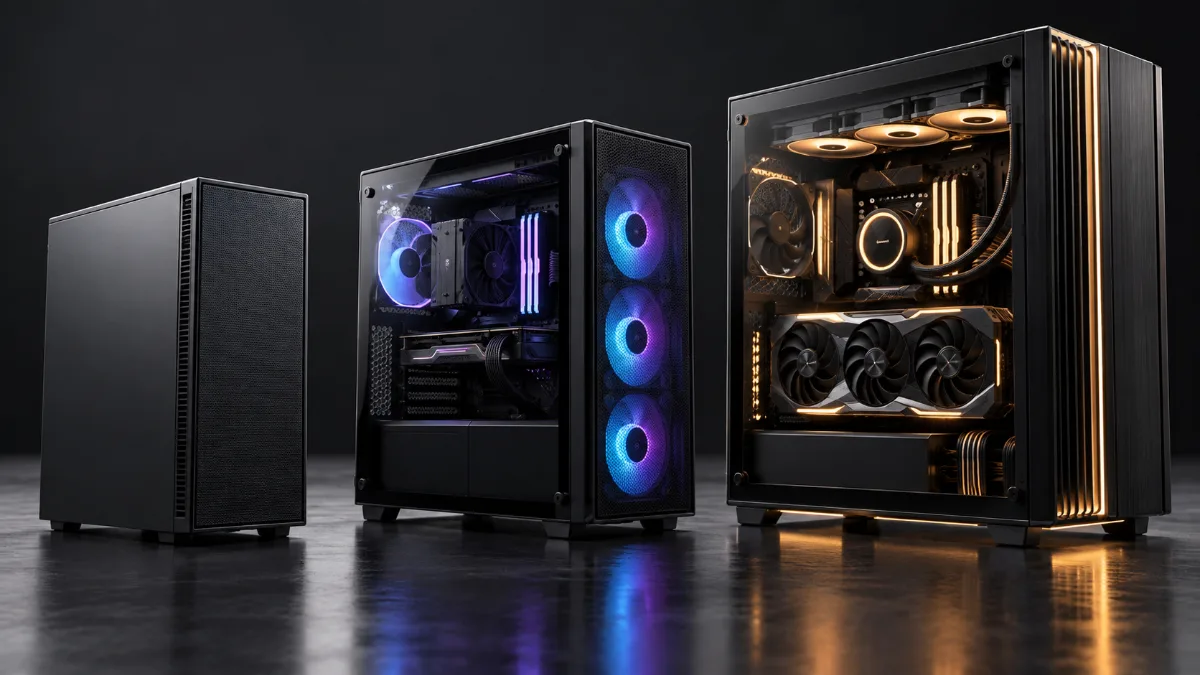
Entry-level, mid-range or high-end: the budget is decided first by your screen and your games.
What budget for a gaming PC in 2026? The table
Here are the ranges you see for a complete, brand-new, pre-built gaming PC in September 2026. Prices include VAT, without a monitor or peripherals.
| Budget | Typical graphics card | What you can expect |
|---|---|---|
| €800 to €1,400 | RTX 5050, RTX 5060, RX 9060 XT 8 GB | Full HD: esports games at high refresh rates, newer games on medium to high settings |
| €1,400 to €1,900 | RTX 5060 Ti 16 GB, RX 9060 XT 16 GB, RX 9070 GRE | Full HD in ultra, 1440p on high settings |
| €1,900 to €2,900 | RTX 5070, RTX 5070 Ti, RX 9070 XT | 1440p in ultra at high refresh rates, 4K within reach |
| €3,000 and up | RTX 5080, RTX 5090 | 4K in ultra, demanding video editing and 3D creation |
Indicative ranges noted in September 2026 for fully built systems; prices move fast, especially those for memory.
Quick reminder of the context: since the end of 2025, strong demand for memory has pushed RAM and SSD prices significantly higher. As a result, in 2026, a balanced PC with 16 GB of RAM still turns out to be a better deal than a configuration that sacrifices the graphics card to go up to 32 GB.
The right budget for your player profile
Casual gamer or esports: up to €1,400
Do you mainly play Fortnite, Valorant, League of Legends, Rocket League or Minecraft on a Full HD screen? These games are not very demanding: a graphics card like an RTX 5050 or RTX 5060, a recent 6-core processor and 16 GB of RAM are enough to play smoothly, with a high frame rate in esports titles.
Regular player: €1,400 to €1,900
You want to enjoy the big releases in good quality, and maybe even move up to 1440p. Aim for a graphics card with 16 GB of video memory (RTX 5060 Ti 16 GB, RX 9060 XT 16 GB): newer games consume more and more, and that’s what will make your PC last longer.
Enthusiast player: €1,900 to €2,900
1440p monitor at 144 Hz or higher, settings at maximum, ray tracing: this is the sweet spot for RTX 5070, RTX 5070 Ti and RX 9070 XT, ideally paired with an AMD X3D processor for competitive games.
4K and creation work: €3,000 and up
4K in ultra or heavy video editing requires an RTX 5080 or 5090, 32 GB of RAM, and robust cooling. For streaming and editing, the processor and RAM matter as much as the graphics card.
Where does the money go in a gaming PC?
The graphics card is the first and biggest expense, and the one that most strongly affects gaming performance. Next come the processor, memory and storage, then the things you notice less but which make a difference over the long term: the power supply, cooling and the case.
A €800 PC and a €5,000 PC don’t just have different graphics cards. Here’s what makes the bill climb:
- The graphics card: from an RTX 5050 to an RTX 5090, the price of the card alone is multiplied by about eight (launch prices announced by NVIDIA: 249 and 1,999 US dollars).
- The processor: a 6-core CPU is enough for gaming; 8-core X3D or 16-core models cost significantly more.
- RAM and the SSD: moving from 16 to 32 GB or from 1 to 2 TB weighs heavily, especially since memory prices have risen.
- Power supply and cooling: a quality power supply and watercooling add cost, but they protect the rest of the PC.
- The case and aesthetics: tempered glass, RGB, an LCD screen on the watercooling, sleeved cables.
- Assembly, warranty and after-sales service: invisible on a spec sheet, but invaluable the day something goes wrong.
For each component, our guides break down the right choices: graphics card, processor, RAM, SSD and power supply.
The 5 mistakes that wreck a budget
- Put everything into the processor and keep a small graphics card: in games, you need to do the opposite.
- Choose a graphics card with too little video memory for 1440p: 8 GB of VRAM just aren’t enough in today’s recent games.
- Skimping on the power supply: a low-end PSU can make the PC unstable, or even damage other components.
- Forget about the SSD: a standalone hard drive makes loading times interminable. An NVMe SSD is essential.
- Buying too much power for your monitor: an RTX 5080 on a 60 Hz Full HD screen is money that’s just sitting idle.
To see one of our PCs in real-world use, here’s the in-games test of our Rift PC (Radeon RX 9060 XT) by Mathis and Gauthier:
Mathis and Gauthier, review of the FlowUP Rift PC, September 2026.
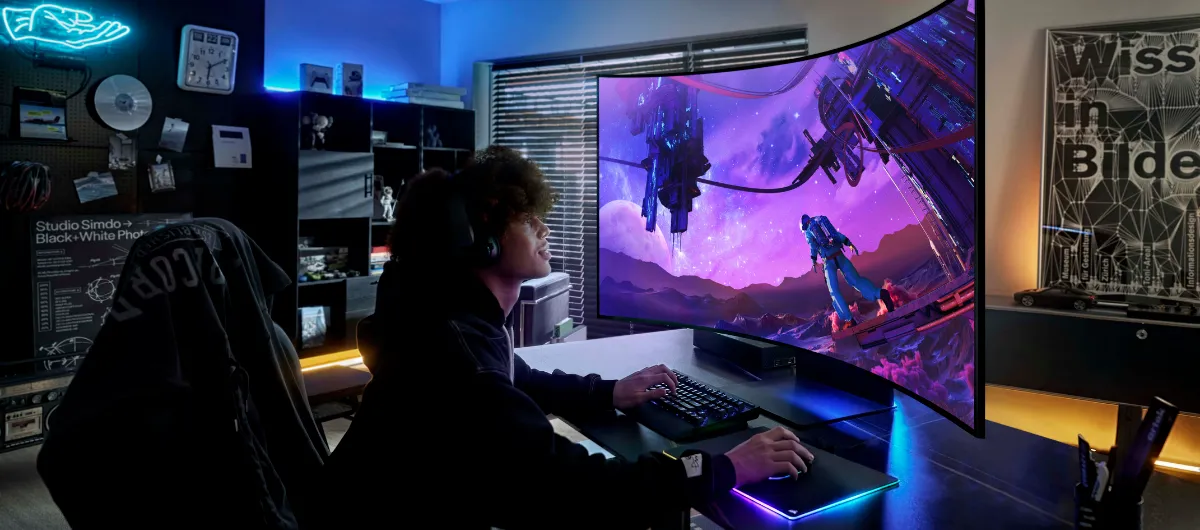
Think about the monitor and peripherals too
A powerful PC connected to an entry-level screen will never show what it can do. Plan the monitor in your overall budget: Full HD at 144 Hz for esports, 1440p at 144 Hz or higher for mid-range and high-end builds, 4K for the most powerful setups. Our full guide to choose a monitor helps you find the right model. On the peripherals side, a precise mouse and a decent headset improve your gaming comfort even more than a few extra FPS.
Our gaming PCs by budget
Our configurations cover every price bracket in the table. A few guidelines:
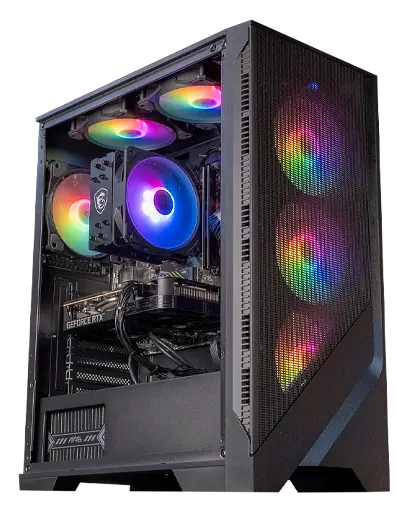
PC Corvus GeForce RTX 5050
To get started in Full HD: RTX 5050, Ryzen 5 5500, and SSD storage.
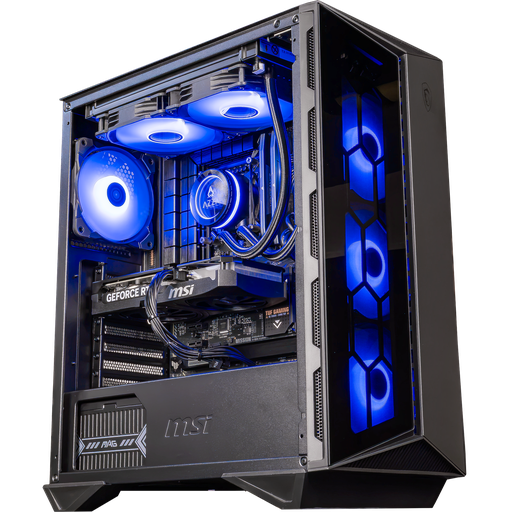
PC Swift GeForce RTX 5060 Ti 16 GB
The regular player: a RTX 5060 Ti with 16 GB of video memory, for Full HD on ultra and 1440p.
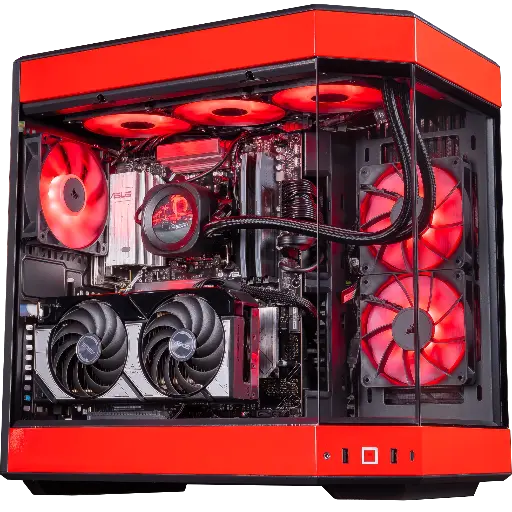
PC Rivals GeForce RTX 5070
The enthusiast: Ryzen 7 9800X3D, RTX 5070, 32 GB DDR5 and 360 mm watercooling for competitive 1440p.
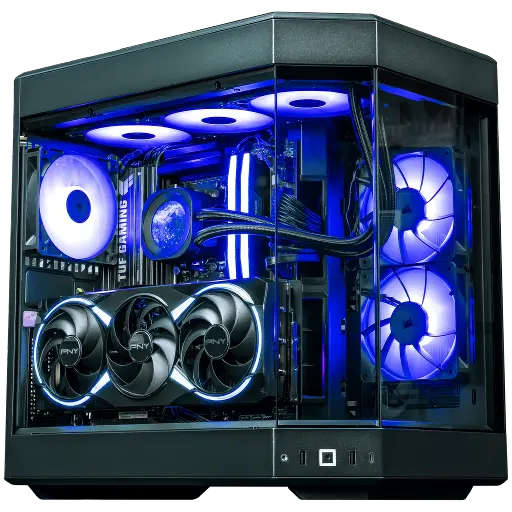
PC Orion GeForce RTX 5080
4K: an RTX 5080 paired with a Ryzen 7 X3D, to play in 1440p ultra and in 4K.
FAQ
What budget for a good gaming PC in 2026?
Between €1,000 and €1,500 for a complete, well-balanced gaming PC that runs all games in Full HD. Budget around €2,000 for 1440p in ultra.
Is a gaming PC for €500 possible?
Brand new and complete, it’s become very difficult in 2026, especially because of rising memory prices. With this budget, you’ll have to accept major trade-offs, buy used, or stick to less demanding games.
Is it better to build your own PC?
Building your own PC lets you learn and choose each component, but the savings are often small once you factor in Windows, the time spent, and the warranties. A pre-built PC arrives tested, with a single warranty covering everything.
How much do you need to play in 4K?
For 4K at high settings, aim for at least an RTX 5070 Ti or RX 9070 XT, so a PC around €2,500. For 4K in ultra in the most demanding games, an RTX 5080 or 5090, starting from €3,000.
Do you need to budget for Windows and peripherals?
Yes: check whether Windows is included, and add the monitor, keyboard, mouse and headset if you’re starting from scratch.
