
By the FlowUP team, a gaming PC builder in Genappe (Belgium) · Updated 28 September 2026
In brief: to game, the AMD Ryzen X3D (7800X3D, 9800X3D, 9850X3D) remain the fastest processors thanks to their large cache. For an all-round PC for gaming and creation, the Ryzen 9 and Intel Core Ultra 7 are evenly matched, the choice comes down to price. For a tight budget, a Ryzen 5 7500F or a Core i5-14400F is enough. Finally, AMD’s AM5 platform is supported until 2029, making future upgrades easier.
Intel or AMD: the debate has been going for more than twenty years, and the answer has often switched sides. In 2026, both brands offer excellent processors, but not for the same use cases.
Rather than picking an outright winner, we decode the line-ups, compare what really matters (gaming, creation, power use, upgradability) and tell you what to choose based on your profile.
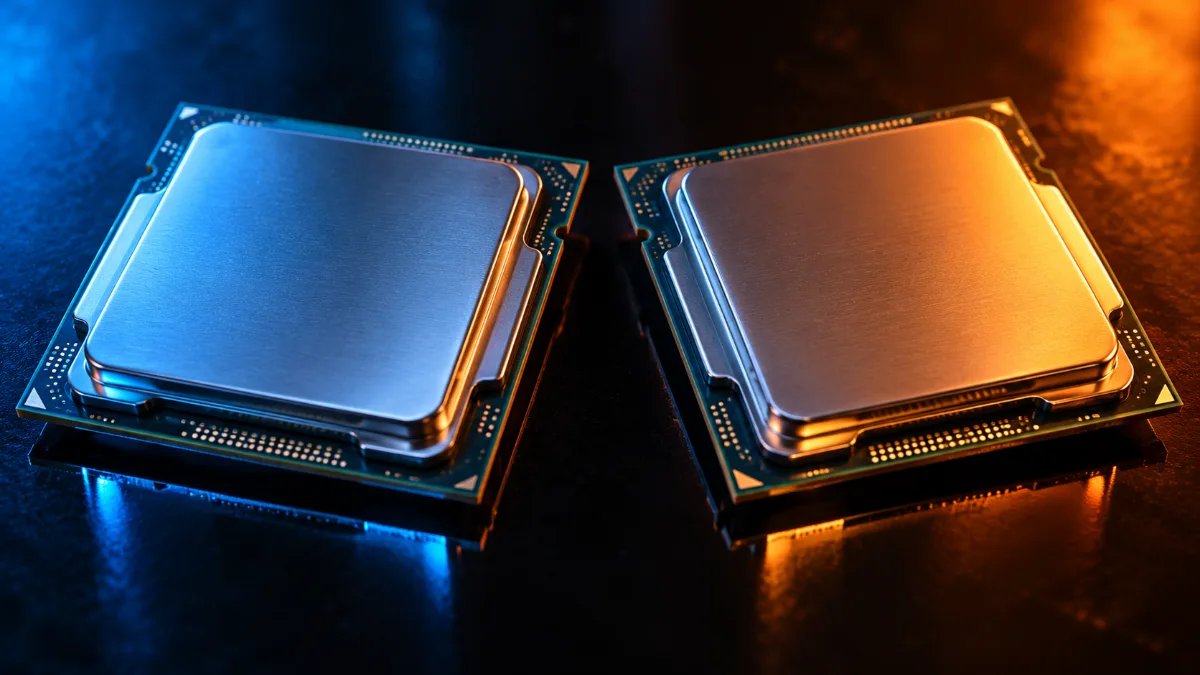
Understanding the Intel and AMD ranges in 2026
| Range | Intel | AMD |
|---|---|---|
| Entry-level | Core i5-14400F, Core Ultra 5 245K / 250K Plus | Ryzen 5 5500 (AM4), Ryzen 5 7500F, Ryzen 5 9600X |
| Mid-range | Core i7-14700K, Core Ultra 7 265K / 270K Plus | Ryzen 7 7700, Ryzen 7 9700X |
| Pure gaming | No direct equivalent | Ryzen 7 7800X3D, 9800X3D, 9850X3D |
| High-end | Core i9-14900K, Core Ultra 9 285K | Ryzen 9 9900X, 9950X, 9950X3D |
| Current socket | LGA1700 (14th gen), LGA1851 (Core Ultra) | AM4 (Ryzen 5000), AM5 (Ryzen 7000 and 9000) |
A few suffixes you should know: K on Intel means the processor can be overclocked, F means it doesn’t have integrated graphics (you need a graphics card). With AMD, X refers to a faster version and X3D to a version with 3D V-Cache, that extra cache that works wonders for gaming. To understand the difference between cores and threads, see our guides on the processor core and the CPU thread.
Intel in 2026: Core Ultra 200S Plus and 14th-gen Core
Intel’s current range is called Core Ultra. The Core Ultra 200S (Arrow Lake architecture, LGA1851 socket) launched in late 2024. Their update, the Core Ultra 200S Plus, arrived on 26 March 2026: the Core Ultra 7 270K Plus has 24 cores (8 performance and 16 efficient), and the Core Ultra 5 250K Plus has 18 cores. Intel claims up to 15% more gaming performance compared with the first-wave Core Ultra, plus support for DDR5-7200.
The 14th-gen Core chips (i5-14400F, i7-14700K, i9-14900K) remain widespread and perform well. In 2024 they ran into a stability issue linked to overly high voltage: Intel fixed it with a microcode update and extended the warranty of the affected models by two years. If you have one, keep your motherboard BIOS up to date.
AMD in 2026: Ryzen 9000 and the X3D family
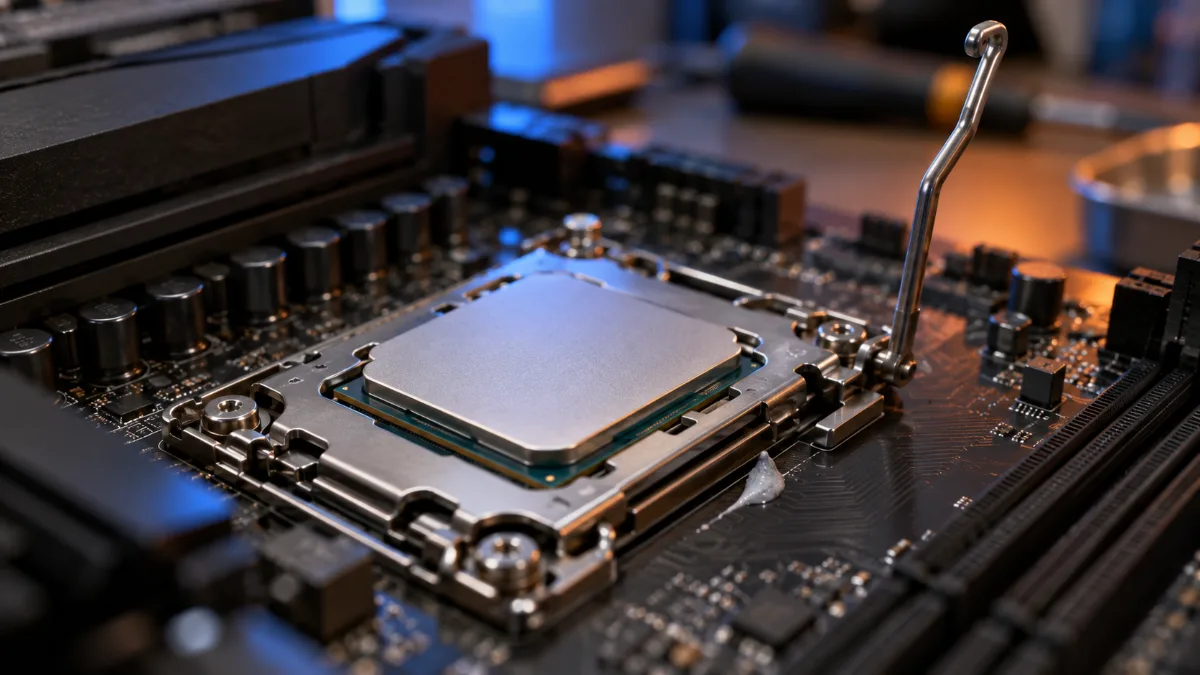
With AMD, the Ryzen 9000 line-up (Zen 5 architecture, AM5 socket) has formed the main range since 2024. The stars are the X3D: Ryzen 7 9800X3D, Ryzen 9 9950X3D and, starting early 2026, the Ryzen 7 9850X3D, which clocks up to 5.6 GHz. The older Ryzen 7 7800X3D still offers an excellent price/performance ratio, as we explain in our review of the 7800X3D.
For smaller budgets, the AM4 platform (Ryzen 5 5500, Ryzen 7 5700X) still offers very affordable gaming PCs, with DDR4 memory.
Intel or AMD: which should you choose based on how you’ll use it?
| Use | On the AMD side | On the Intel side | Our take |
|---|---|---|---|
| Pure gaming, 1080p or 1440p at high refresh rates | Ryzen 7 7800X3D, 9800X3D, 9850X3D | Core Ultra 7 270K Plus | AMD X3D, the fastest for gaming |
| Gaming and streaming or video editing | Ryzen 9 9900X, 9950X3D | Core Ultra 7 265K / 270K Plus, Core i7-14700K | A draw, depending on current pricing |
| Heavy creation (3D rendering, encoding) | Ryzen 9 9950X | Core Ultra 9 285K | A draw |
| Budget gaming | Ryzen 5 7500F, Ryzen 5 5500 | Core i5-14400F | Depending on promotions |
Mathis and Gauthier published their top 10 gaming processors in May 2026. A good addition to our table if you’re torn between two specific models.
Platform and upgradability: AMD’s advantage
The processor is also a motherboard and a socket for several years. AMD has confirmed it will support the AM5 socket until 2029: a motherboard bought today will be able to take future Ryzen CPUs. At Intel, the current Core Ultra chips use the LGA1851 socket, and the next generation (Nova Lake, Core Ultra 400 series) is announced for a new socket, LGA1954. So for upgrading later without changing your motherboard, AMD is starting ahead.
Power consumption and heat
AMD’s X3D CPUs are remarkably power-efficient under load. By contrast, high-end 14th-gen Core models can draw a lot of power when pushed hard and require robust cooling. Core Ultra has noticeably narrowed that gap. In all cases, make sure you have a suitable air cooler or watercooling for the processor: that’s what ensures stable clock speeds and a quiet PC.
Our Intel and AMD gaming PCs
We offer both brands, depending on what suits each configuration best. Two examples:
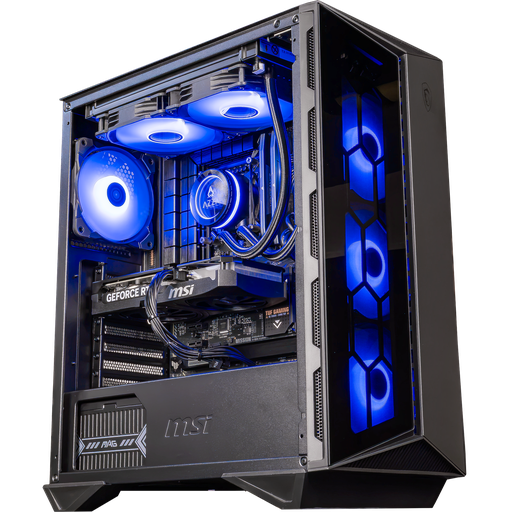
Swift PC: Intel Core i5-14400F + RTX 5060 Ti 16 GB
A versatile, upgradeable Intel base for gaming at 1080p and 1440p, streaming and creating.
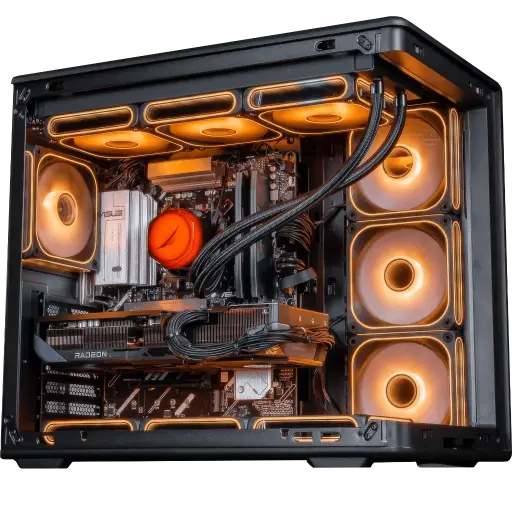
Apex V2 PC: AMD Ryzen 7 7800X3D + RX 9070 XT
The X3D processor that made waves in PC gaming, paired with a card built for 1440p and 4K.
Looking higher up on the Intel side? The PC Arctic pairs a Core Ultra 7 265KF with an RTX 5080. And to choose the rest of the configuration, read how to choose your gaming PC setup well or which PC to play all games.
Frequently asked questions
Intel or AMD for gaming in 2026?
AMD, if you want the maximum frames per second: the Ryzen X3D chips remain the fastest for gaming. Intel is still a very good choice for an all-round PC, especially when its processors are on offer.
What is the best gaming processor in 2026?
The Ryzen 7 9850X3D and Ryzen 7 9800X3D top the charts in most tests. The 7800X3D offers a better performance/price ratio.
Is an i5 Core or Ryzen 5 enough to play?
Yes. A Core i5-14400F or a Ryzen 5 7500F runs all current games, with the graphics card counting far more for performance.
Are 14th-gen Intel CPUs reliable?
Yes, with an up-to-date BIOS. Intel fixed the instability issue via a microcode update and extended the warranty for the affected models.
Should you wait for the next generations?
Intel Nova Lake and AMD Zen 6 are expected in 2027 based on the information available. If you need a PC now, the current models remain excellent, and AM5 keeps the door open to future Ryzen CPUs.
