Your PC in instalments (up to 12x)
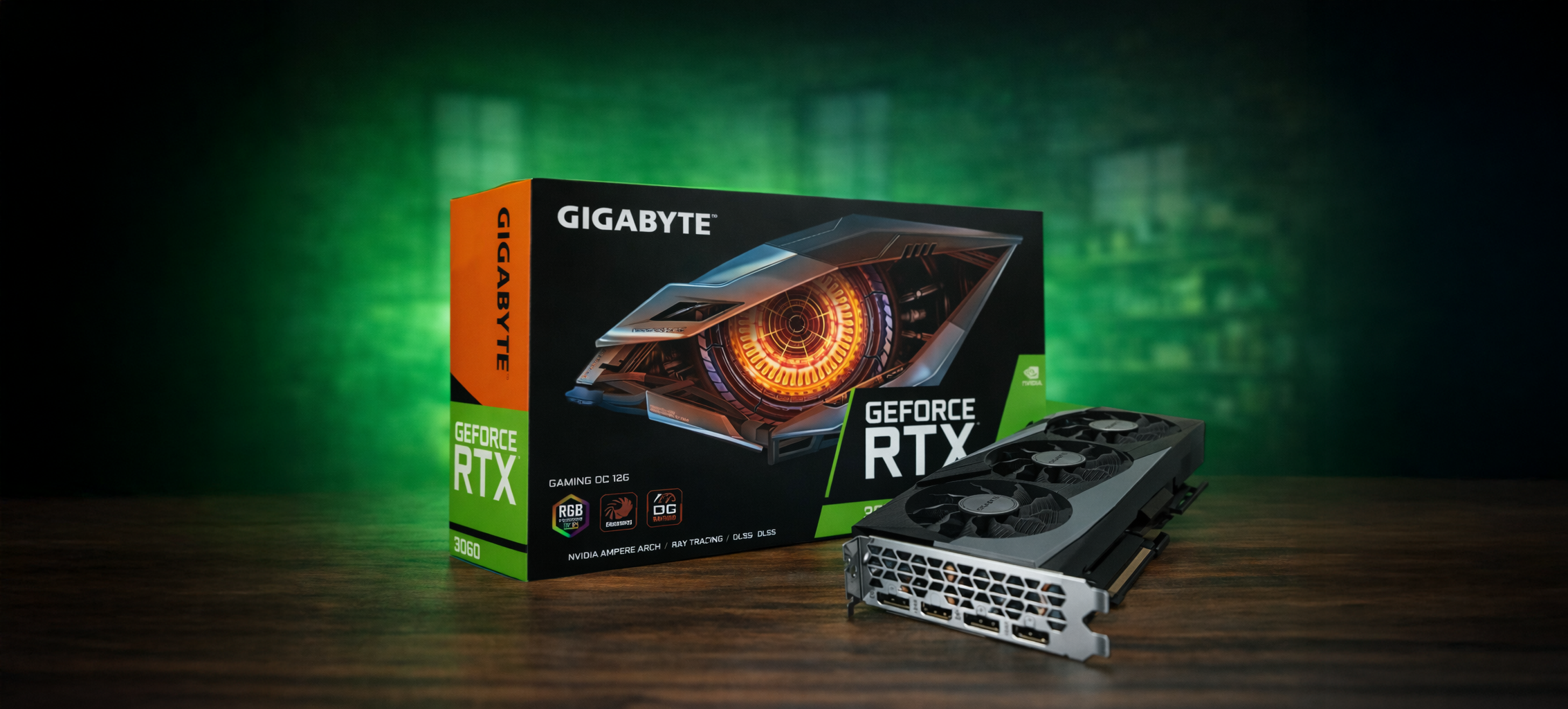
The NVIDIA GeForce RTX 3060, released in 2021, was for a long time a reference point for 1080p gamers—and even moderate 1440p when it first launched.
Nvidia would even be preparing its return onto the front stage!
In 2026, with GPUs evolving rapidly and newer generations arriving, its positioning has changed: it’s no longer the mid-range darling, but it can still hold some value depending on how you use it.
Where does the RTX 3060 stand today?
At launch, the RTX 3060 relied on the Ampere architecture, offering:
- 3584 CUDA cores
- 12GB GDDR6 memory
-
PCIe 4.0 support
and technologies like ray tracing and DLSS, which boosted the performance-to-quality ratio 📊
In 2026, this configuration is still capable of smooth gaming in 1080p, but compared with today’s standards it also shows its limits:
Current strengths
- Solid 1080p gaming in many titles, especially with DLSS or FSR enabled
- 12GB of VRAM, still useful for certain heavy tasks and high resolutions in less demanding games
- Still compatible with basic ray tracing
Clear limitations
- Compared with recent GPUs like the RTX 4060/5060 or higher generations, the 3060 is significantly less powerful, especially in ray tracing and frame generation.
- At higher resolutions (1440p/4K) or with maximum graphics options, performance drops off quickly
- It’s been replaced in the official catalogue for a long time now, and brand-new stock has almost disappeared in 2025/2026
what gaming performance today?
1080p: still viable
The RTX 3060 generally lets you play at 60 FPS or higher on popular 1080p titles with medium/high settings—especially if you enable DLSS or FSR to offset the cost of demanding graphics effects.
1440p: possible, but needs tweaking
It can reach playable performance in 1440p on less demanding titles, or with upscaling, but it’s no longer ideal for high/ultra settings in recent AAA games.
Ray tracing
The card handles ray tracing, but it has no efficiency compared with newer GPUs featuring improved RT and Tensor cores.
the RTX 3060, compared with current options
| Card | 1080p use | Ray Tracing | Longevity |
|---|---|---|---|
| RTX 3060 | Good | Average | Average |
| RTX 4060 / 5060 | Very good | Best | Best |
| RX 6600 XT / 6600 | Similar | Average | Average |
👉 In 2026, next-generation GPUs (such as the RTX 4060 or 5060) offer better overall performance and modern technologies, especially in recent titles and ray tracing.
Should you still buy it in 2026?
Maybe if:
- You want an affordable GPU on the used market
- You mostly play in 1080p without extreme ray tracing
- You want a card that remains capable in eSports titles and less demanding games
Absolutely not if:
- You want a powerful GPU for recent AAA titles
- You’re aiming for advanced ray tracing
- You’re building a setup designed to last several years without an upgrade
The RTX 3060 in 2026 isn’t what it was at launch, but it still has real use-value in 1080p, especially if you find it for a good price.
It’s still a sensible option for budget gamers who aren’t looking for the absolute latest graphics at maximum settings, but newer GPUs have outpaced it in terms of raw power and modern technologies.