 Pay for your PC in installments (up to 12 payments)
How good are the latest AMD RX 7700XT and RX 7800XT GPUs?
YANNICK GUERRINI, 7 September 2023 18:21
After a long period of anticipation, AMD has finally officially announced the new Radeon RX 7700 XT and 7800 XT graphics cards. Now it’s time to explore them in depth!
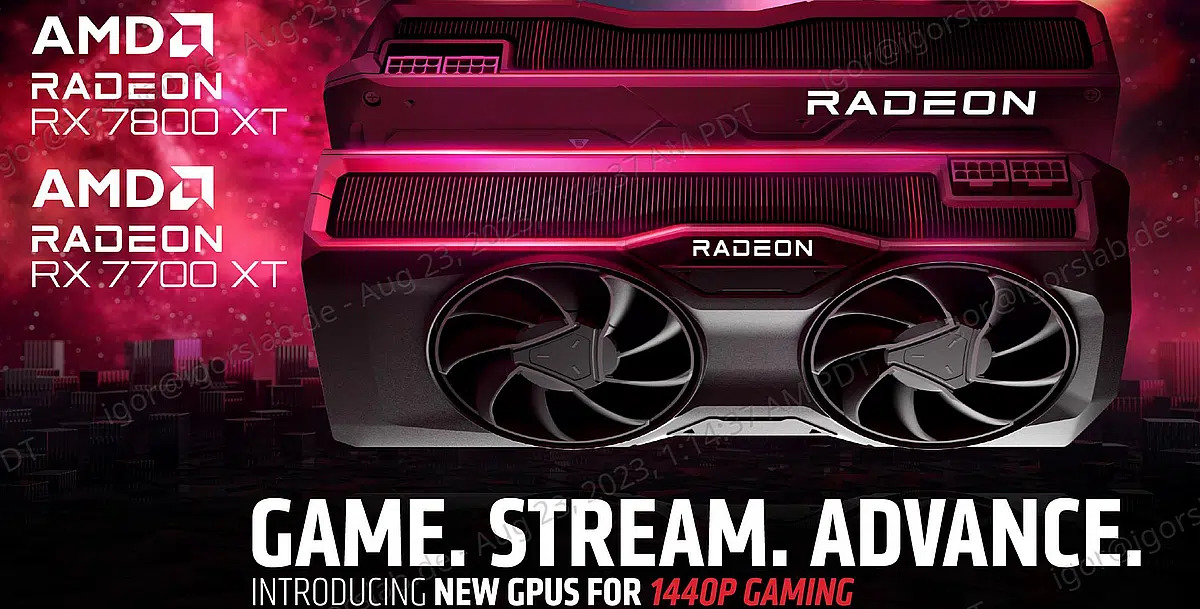
Until now, AMD’s RDNA 3 graphics-card lineup consisted only of Radeon RX 7900XT/XTX as the high end, and the small RX 7600 as the entry level. In between, there was nothing available (deliberately ignoring the RX 7900 GRE, which—despite being cheaper—was reserved for the Asian market and therefore only marginally available and interesting in our regions). No next-generation Radeon had been able, so far, to replace the Radeon RX 6000 Series in the mid-range, which has delayed their long-overdue retirement. However, that’s now a thing of the past with the new Radeon RX 7700 XT and 7800 XT, officially unveiled by AMD last 25 August. We’re now in a position to present them to you in detail.
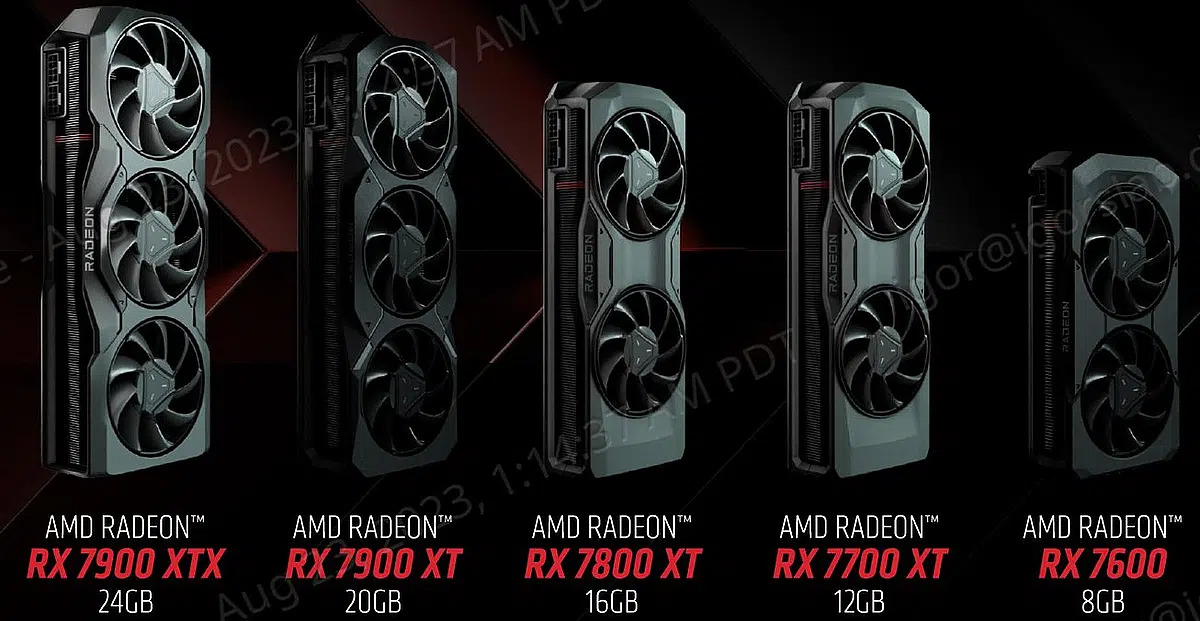
AMD has taken its time to close the gap between the 7900 XT and the RX 7600, relying up to now on its previous-generation graphics cards to keep waiting gamers satisfied. Meanwhile, NVIDIA hasn’t hesitated to move in by launching its GeForce RTX 4060 (Ti) and RTX 4070 (Ti), flooding the market. In anticipation of the arrival of the new Radeon models, NVIDIA has even recently lowered the price of its RTX 4060 Ti 16GB and is considering adjusting the pricing of some other GeForce RTX models soon. This strategy could well pose a challenge for the RX 7700 XT and RX 7800 XT from day one.
Features tailored for the mid-range
The Radeon RX 7700 XT and RX 7800 XT are equipped with features suited to the mid-range. The RX 7700 XT is based on a Navi 32 XL chipset, while the RX 7800 XT uses a Navi 32 XT chipset. The first is a version with a few fewer compute units (Compute Units, Shaders Units, and other RT and AI accelerators) than the second. What’s more, although the RX 7800 XT benefits from the same 256-bit memory bus as the 7900 XT (offering a bandwidth of 624 GB/s), the RX 7700 XT has a memory bus limited to 192 bits, giving it a bandwidth of 432 GB/s.
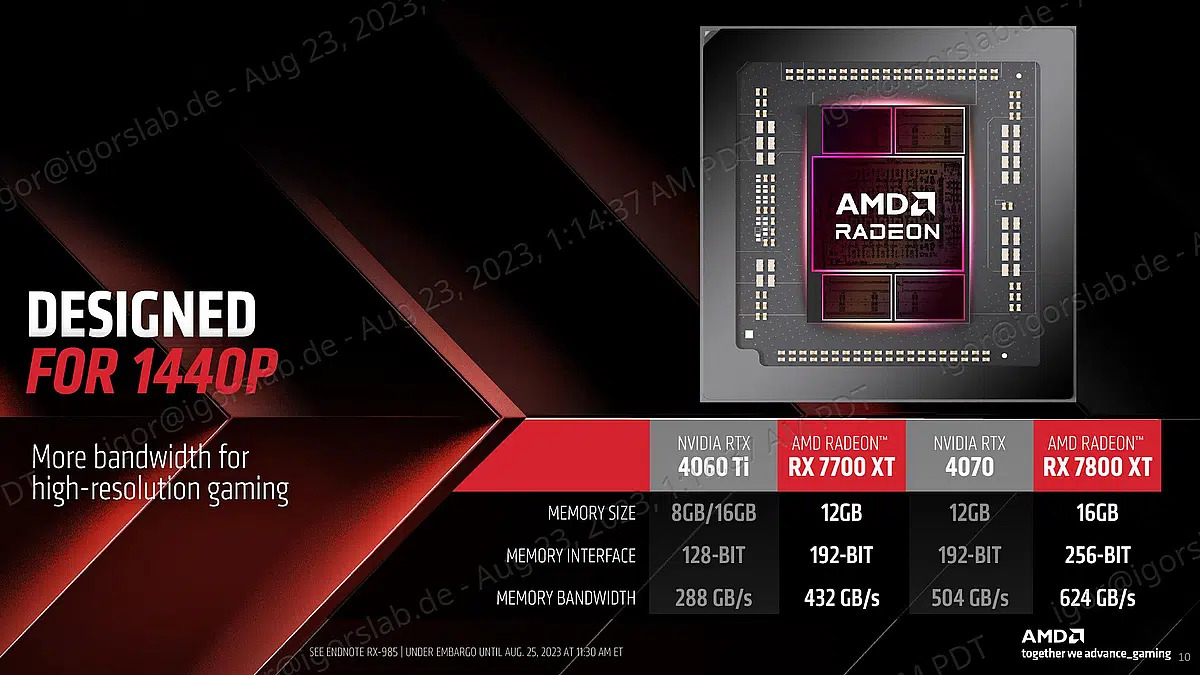 The Navi 32 GPU in these new Radeon cards includes all the features of the RDNA 3 architecture, including hardware-accelerated ray tracing. It also benefits from the same 5nm/6nm TSMC fabrication technology as the Navi 31 and Navi 33 chips. This graphics processor uses an MCM design (Multi-Chip-Module), including an MCD (Memory Complex Die) occupying an area of around 200 mm², and four GCD chiplets (Graphics Complex Die) of 36.6 mm² each. The Navi 32 interposer covers a total area of 346 mm². For a clearer overview, here is a summary table of the full specifications below.
Goal: play in QHD with the settings at their maximum
AMD therefore positions its Radeon RX 7700 XT directly against the GeForce RTX 4060 Ti 16GB. According to data provided by the manufacturer, the 7700 XT is expected to deliver a significant advantage in QHD resolution (Quad High Definition)—a native resolution, as AMD is keen to point out—in many games. The aim of this card is to provide enough power to enable a QHD gaming experience with an average of 60 frames per second, while keeping graphical details set to maximum, all without relying on techniques such as super-resolution or intelligent upscaling.
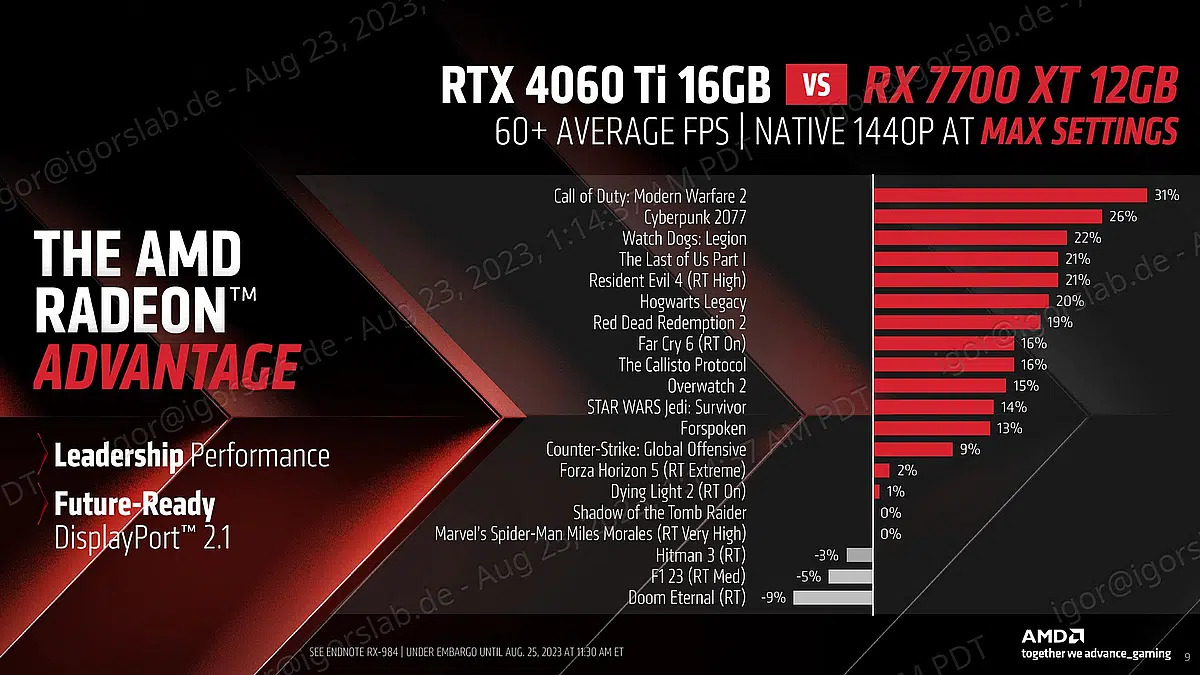 As for the Radeon RX 7800 XT, it sits in the same segment as the RTX 4070 12 GB, touting "33% extra memory" and, according to the information provided by AMD, it also shows a slight performance advantage, particularly at QHD resolution with the graphics settings set to the maximum.
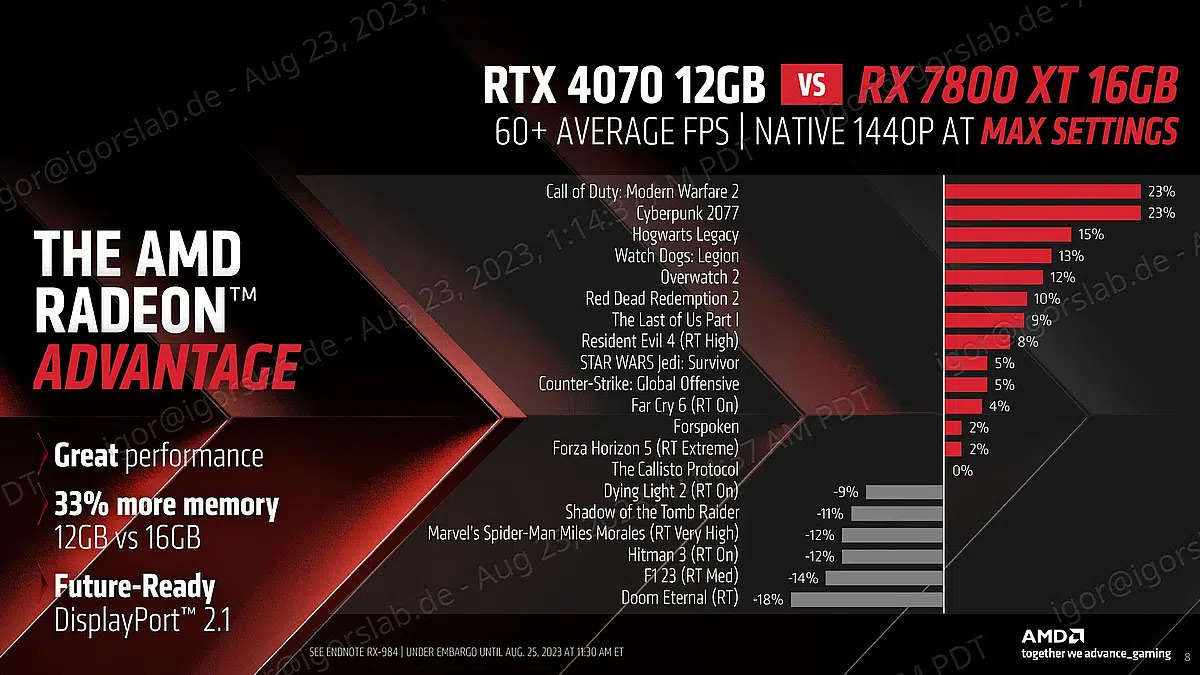
The manufacturer, it seems, is indeed showing a certain confidence in the performance of its new graphics cards compared with competing models. However, it’s still wise to rely on independent testing to confirm or refute these apparently very positive results. The objective evaluations carried out by third parties will allow consumers to make informed decisions and to better understand the real-world performance of these cards in a variety of gaming scenarios.
Radeon RX 7700 XT and 7800 XT: what gaming performance?
The gaming performance of the Radeon RX 7700 XT and 7800 XT has been tested in collaboration with Igor's Lab, and the results are based on a selection of games that combine both traditional rendering (rasterisation) and ray tracing. The panel of games used to evaluate the performance of AMD and NVIDIA cards includes 10 titles, 4 of which use ray tracing: Anno 1800, Cyberpunk 2077, Far Cry 6, Horizon Zero Dawn, Marvel's Guardians of the Galaxy, Metro Exodus EE, Rainbow Six: Extraction, Shadow of the Tomb Raider, A Total War Saga: Troy, and Watch Dogs Legion. Most of these games use the DirectX 12 API, with the exception of Troy, which uses DirectX 11. All games were tested at FHD (Full High Definition) and QHD (Quad High Definition) resolutions with the graphics settings set to the maximum.
These tests make it possible to assess the performance of these new graphics cards more accurately across a variety of gaming scenarios, including those that use ray tracing, which is becoming increasingly common in modern games. The test results will provide a more precise indication of the ability of the Radeon RX 7700 XT and 7800 XT to handle different titles and graphics configurations.
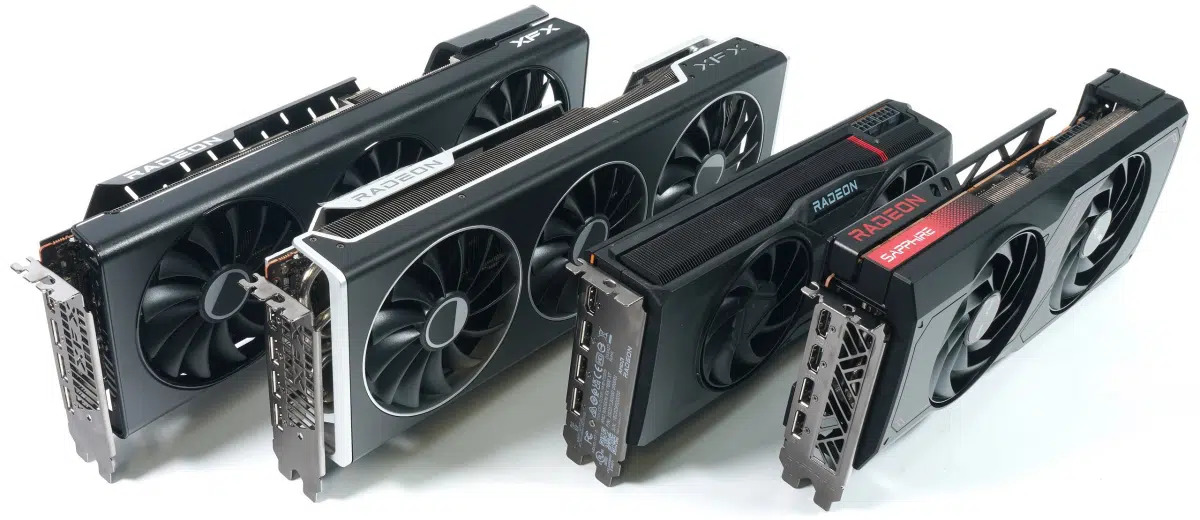
The test platform used is, of course, the same as usual, made up of an AMD Ryzen 9 7950X processor, an MSI MEG X670 Ace motherboard, two 16 GB DDR5-6000 Corsair Dominator RGB sticks (CL30), two 2 TB SSDs (MSI Spatium M480) and a Be Quiet Dark Power Pro 12 1500W power supply, all housed in a Fractal Meshify 2 XL case. Cooling is provided by a water-cooling system consisting of an Alphacool Apex and a Be Quiet! Silent Loop II 360. The operating system used is up-to-date Windows 11 Pro 22H2 with the latest drivers.
When it comes to the GPU clock speeds of these cards, it’s important to note that these actual clocks vary depending on a range of parameters such as the default clock frequency, the power and voltage limit, temperature, load, and so on. Here are the average frequencies reached during the tests, as well as the maximum Boost frequency. AMD announces gaming default and Boost frequencies of 2171/2544 MHz for the RX 7700 XT and 2124/2430 MHz for the RX 7800 XT.
| Model | Average frequency | Maximum Boost frequency |
|---|---|---|
| AMD Radeon RX 7800XT MBA 16 GB | 2462 MHz | 2546 MHz |
| XFX Radeon RX 7800XT MERC 16 GB | 2509 MHz | 2598 MHz |
| XFX Radeon RX 7700XT QICK 12 GB | 2604 MHz | 2671 MHz |
| Sapphire Radeon RX 7700XT Pulse 12 GB | 2594 MHz | 2662 MHz |
Global 3D performance
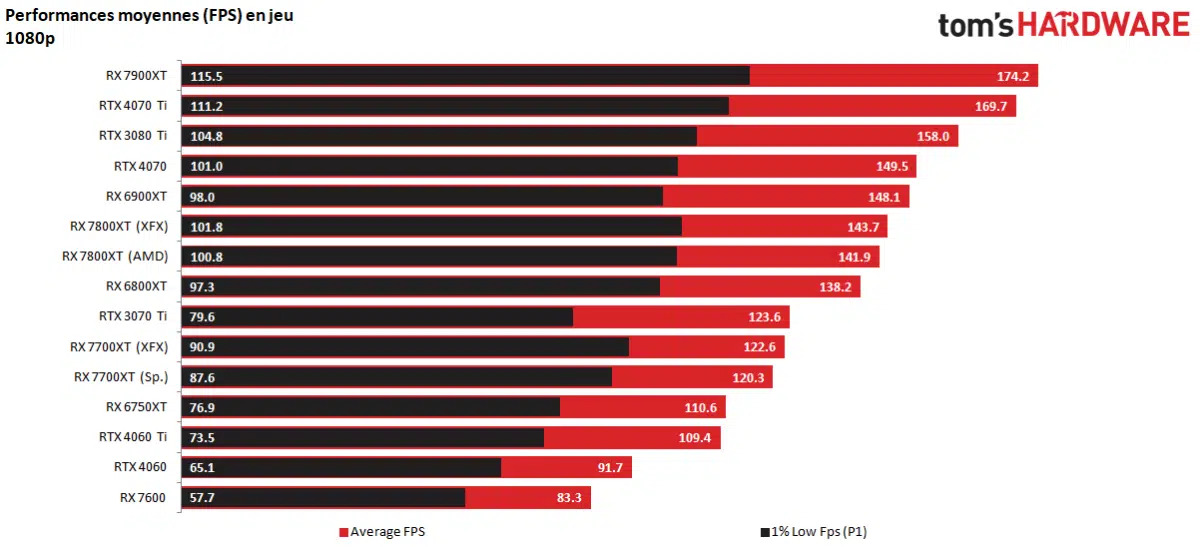
The "Made by AMD" version of the Radeon RX 7800 XT shows an advantage of around 3% over the older Radeon RX 6800 XT at Full HD (FHD) resolution, while the XFX model, which has been overclocked, manages to pick up a few additional tenths of a point. It’s important to note that at this resolution, games that primarily use rasterisation are often limited by the CPU’s computing power rather than by the GPU’s.
In all cases, the RX 7800 XT sits at around 4% behind the RTX 4070. As for the two Radeon RX 7700 XT cards, they fall between the performance of the RTX 3070 Ti and the RX 6750 XT. It seems that, given these results, this latest model no longer really has a place in AMD’s product lineup.
These figures provide an overview of the relative performance of these graphics cards in FHD gaming conditions, but it’s important to note that performance can vary depending on the resolution and graphics settings chosen, as well as on specific game titles.
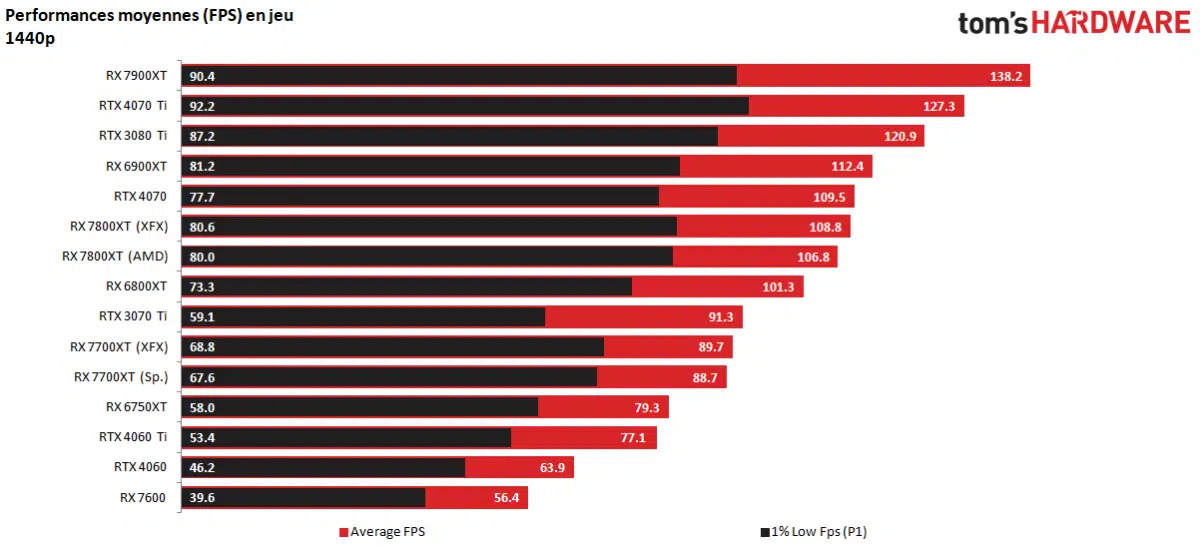
Moving to the QHD (Quad High Definition) resolution highlights performance differences between the various graphics cards, as the impact of the processor on performance decreases as screen definition increases. In this context, the reference Radeon RX 7800 XT now outperforms the RX 6800 XT by 5.5%. In addition, thanks to the XFX card’s overclocking, it manages to trade blows with the RTX 4070 in terms of performance.
As for the RX 7700 XT, both cards deliver, on average, noticeably higher performance than the RTX 4060 Ti in our game roster, whether ray tracing is enabled or not. They sit almost at the level of an RTX 3070 Ti in terms of performance, placing them solidly in the mid-range tier with strong QHD results.
Gaming performance with DLSS / FSR
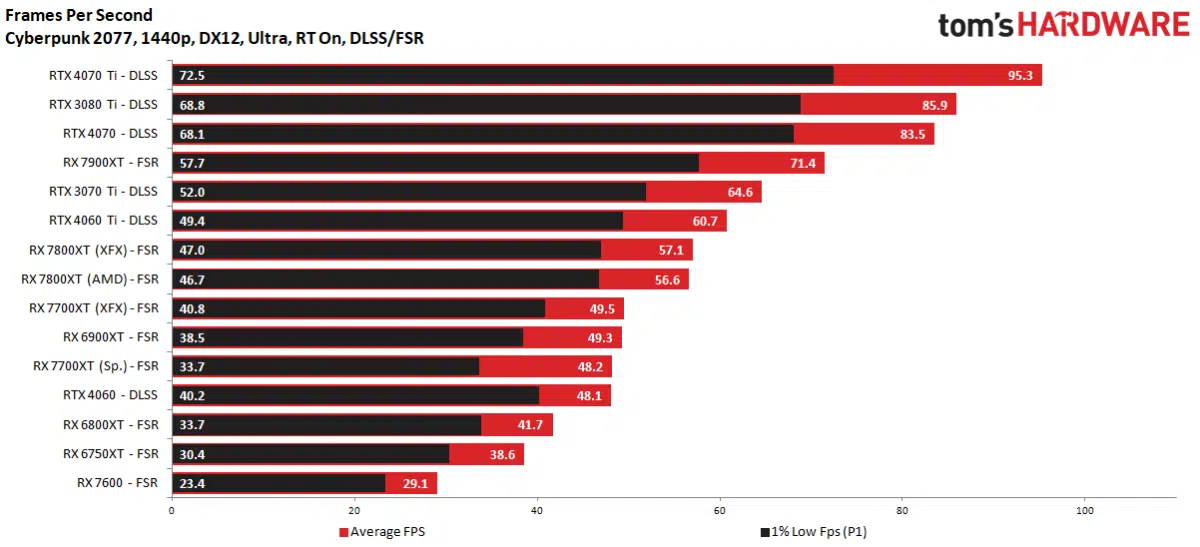
It’s true that both AMD and NVIDIA offer their own "intelligent" upscaling technologies to improve gaming performance while maintaining a decent image quality. However, it’s important to note that NVIDIA’s DLSS (Deep Learning Super Sampling) has been praised for its performance and image quality, which has given it a significant advantage over AMD’s FSR (FidelityFX Super Resolution) in testing.
What’s more, it’s also worth pointing out that the latest versions of DLSS, such as NVIDIA’s DLSS 3.0 and 3.5, have further improved performance and image quality compared with DLSS 2.0. By contrast, AMD’s FSR 3 still appears to be awaiting widespread adoption in games, which means its impact and effectiveness could eventually increase as more titles support it.
Energy efficiency isn’t quite there yet
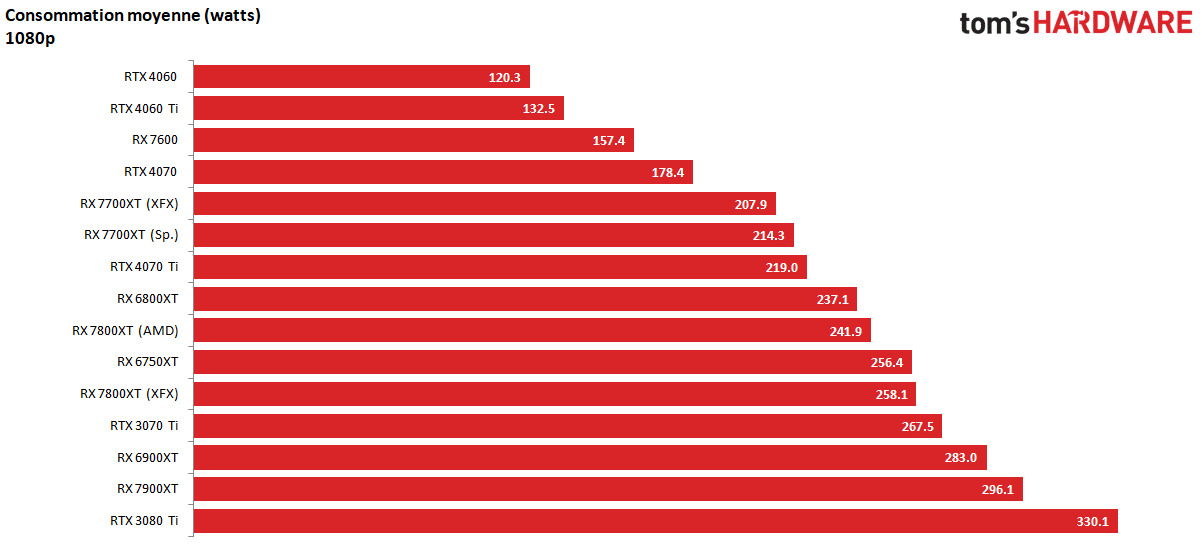
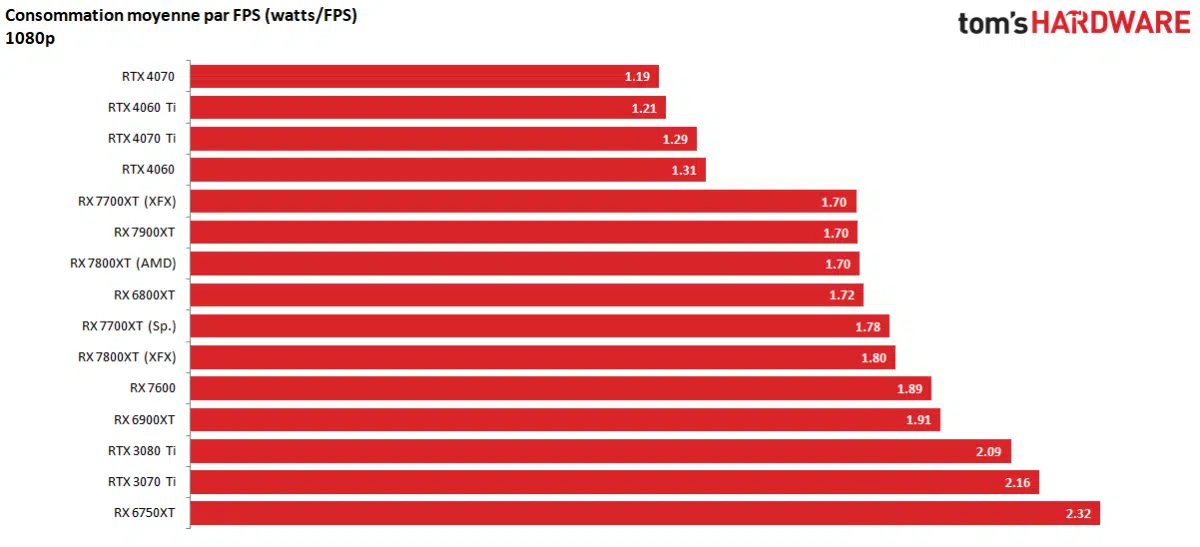
It seems that, despite slight improvements in energy efficiency with the RDNA 3 architecture, AMD’s latest Radeon graphics cards still lag behind NVIDIA’s competitors in terms of power consumption. This difference is especially noticeable when comparing Radeon cards with their competing GeForce RTX counterparts, particularly the RTX 4060 (Ti) and 4070 (Ti), which appear to offer good energy efficiency.
It’s also interesting to note that the overclocked versions of the RX 7700 XT and 7800 XT tend to have a less favourable watts-to-FPS ratio than the reference versions. That means they consume more power to achieve similar performance, which could be a factor to consider if energy efficiency is an important concern for a given user.
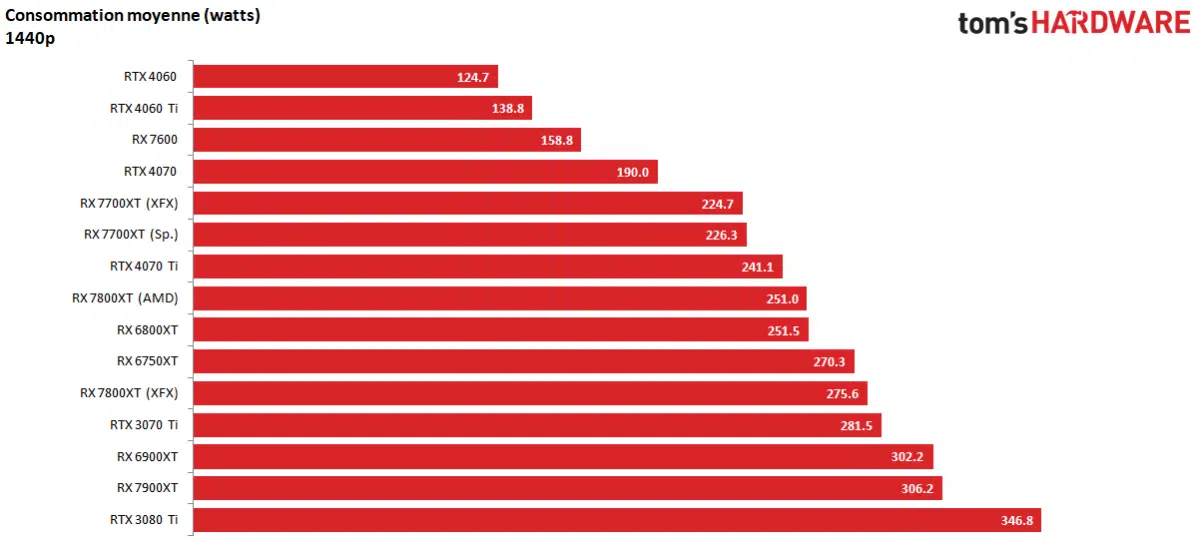
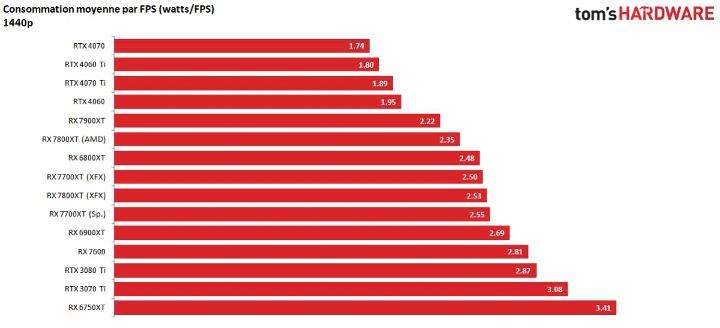
The conclusion is the same in QHD: XFX’s overclocked 7800 XT shows energy efficiency well below AMD’s MBA version. The gap between the base version and the overclocked RX 7700 XT model is smaller, but in absolute terms, it’s still the GeForce RTX Ada Lovelace cards that are in the lead.
In short: an RX 7700 XT that’s more compelling than its predecessor
In conclusion, AMD’s Radeon RX 7800 XT with 16 GB is deliberately positioned at a price of around €570, placing it below NVIDIA’s RTX 4070 12 GB. Although it outperforms the GeForce in rasterisation rendering, the 7800 XT is nevertheless noticeably behind its rival as soon as ray tracing is enabled or when using intelligent upscaling technologies—areas where NVIDIA currently has the advantage. In addition, the card’s power consumption is also a cause for concern for AMD, with a significant gap of nearly 60 watts compared with the RTX 4070 for the reference version, and more than 80 watts for XFX’s overclocked model.
In the end, if we also take into account the relatively small performance improvement compared with the Radeon RX 6800 XT (except in ray tracing), we can conclude that the RX 7800 XT holds its own mainly because of its lower price compared with the RTX 4070. This situation could persist until NVIDIA also adjusts the pricing of its GeForce cards, which could potentially change the balance in the graphics card market.
The Radeon RX 7700 XT appears to stand out, especially when considering that its performance is sufficient for QHD resolution. It occupies a market segment that is not directly competing with the RTX 4060 Ti: it is cheaper but slightly less capable overall. What’s more, it also rules out the Radeon RX 6750 XT from the list of graphics cards worth considering.
However, one drawback remains, similar to its big sister: high power consumption. This means the card struggles to match the competition in terms of energy efficiency. This can be a factor worth taking into account, especially for users concerned about the energy impact of their system or the heat generated by the card.
The Radeon RX 7700 XT could very well be an interesting option for anyone looking for strong QHD performance without having to spend as much as on high-end cards, but it’s important to weigh up the pros and cons based on your specific needs and setup.
Discover the Tom’s Hardware website: https://www.tomshardware.fr/
