 Your PC in instalments (up to 12x)
By the FlowUP team, gaming PC builder in Genappe (Belgium) · Updated 1 October 2026
In short: an APU is a processor that includes a fairly powerful graphics section for playing lighter games, such as the Ryzen 7 8700G and its Radeon 780M (12 compute units). An iGPU refers to any graphics chip integrated into the processor; the one on the Ryzen 9000 has only 2 compute units and is mainly used to display Windows. A dedicated graphics card has its own memory (VRAM) and up to dozens of compute units: that’s the one you need for high settings at 1080p, 1440p or 4K.
APU, iGPU, GPU: definitions
The GPU (Graphics Processing Unit) is the chip that calculates the images. It can be found in two places: on a dedicated graphics card, or directly inside the processor.
When it’s inside the processor, it’s called an iGPU (integrated GPU). AMD calls APUs its processors whose graphics section is strong enough for gaming, such as the Ryzen 8000G series. So every APU has an iGPU, but not every iGPU is an APU: the small chip in the Ryzen 7000 en 9000 only covers you for basic needs, that’s it.
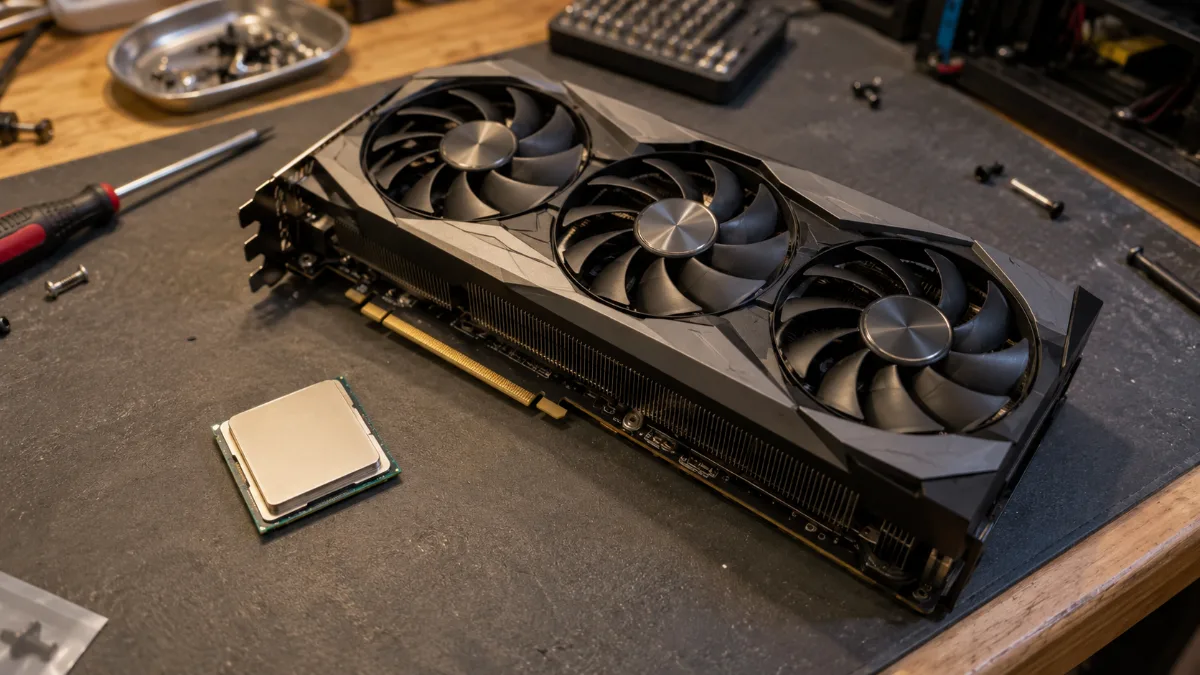
Integrated graphics or dedicated graphics card: two worlds of performance.
The differences at a glance
| Graphics chip | Type | Compute units | Memory | What it’s for |
|---|---|---|---|---|
| Radeon Graphics (Ryzen 7000 and 9000) | iGPU | 2 | Shared PC memory | Display, basic troubleshooting |
| Radeon 780M (Ryzen 7 8700G) | APU | 12 | Shared PC memory | Light games at 1080p, low settings |
| Radeon RX 9060 XT | Dedicated card | 32 | 16 GB of GDDR6 | High at 1080p and 1440p |
| Radeon RX 9070 XT | Dedicated card | 64 | 16 GB of GDDR6 | 1440p ultra and 4K |
Source: AMD, official specifications. Here we compare AMD chips with each other, because compute units can’t be compared across different brands.
The gap isn’t only down to the number of compute units. An iGPU and an APU draw on the PC’s main memory, which is much slower than the VRAM of a graphics card. They also share the processor’s power envelope: 65 W for the Ryzen 7 8700G in total, versus 160 W for the Radeon RX 9060 XT by itself.
How good is an APU for gaming?
For an APU, that’s respectable. Tom’s Hardware tested the Ryzen 7 8700G in January 2024: on its own integrated graphics chip, it’s 10% faster than the Ryzen 5 8600G in 1080p, and 81% faster than the Ryzen 7 5700G from the previous generation. The test compares it with a GeForce GTX 1650, an entry-level card from 2019, and notes that going further means lowering image quality with upscaling.
Put simply: an APU runs competitive, not-too-demanding games and indie games in 1080p with low settings. For recent games at high quality, ray tracing, or a 144 Hz screen, you need a dedicated graphics card. Our article on the FPS count explains why each frame matters.
Why a gaming PC has a dedicated graphics card
- Power: 32 to 64 compute units on our Radeon cards, compared with 12 for the best APU from AMD.
- VRAM: up to 16 GB of fast memory reserved for textures, instead of having to pull from the PC’s RAM.
- Technologies: DLSS 4 on GeForce RTX 50, FSR 4 on Radeon RX 9000, accelerated ray tracing using dedicated units.
- Evolution: you change the graphics card without touching the processor.
Our builder’s advice: always connect the monitor to the graphics card, never to the motherboard. This is a common mistake on a brand-new PC: the game runs on the iGPU, or the screen stays black if the processor doesn’t have one.
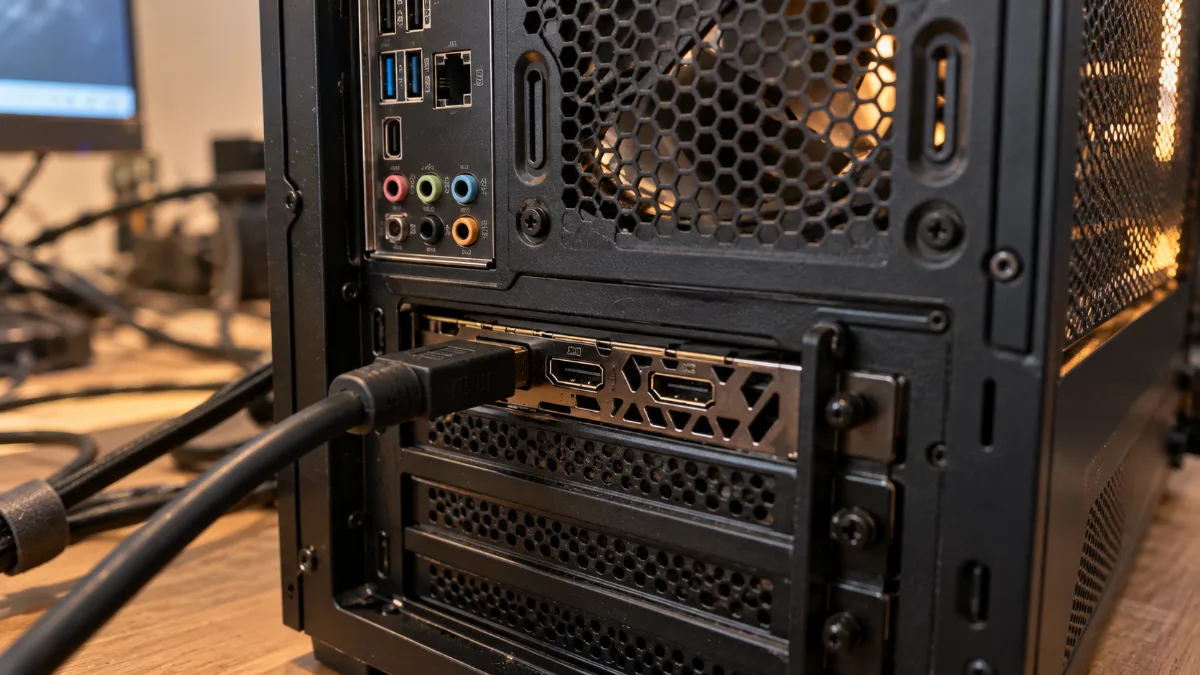
The monitor cable goes to the graphics card, at the bottom of the case, not to the motherboard.
Mathis and Gauthier tested our Rift PC and its Radeon RX 9060 XT 16 GB, a mid-range dedicated card:
Mathis and Gauthier: test of the FlowUP Rift PC (Radeon RX 9060 XT 16 GB).
The iGPU, useful for troubleshooting
An iGPU stays useful: if the graphics card fails, it allows you to display Windows and diagnose the problem. Watch out for processors whose name ends with F (Ryzen 5 7500F, Core i7-14700KF): they don’t have an iGPU at all. Without a graphics card, the screen will stay black. If your PC refuses to display anything, our guide my computer won’t start explains what to do next.
Our gaming PCs with a dedicated graphics card
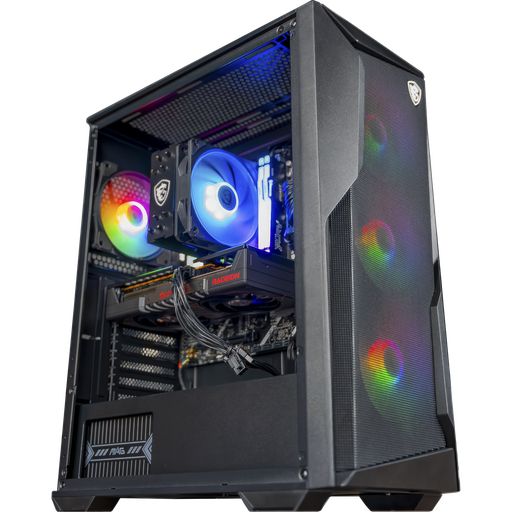
Rift PC: Radeon RX 9060 XT 16 GB
Radeon RX 9060 XT 16 GB and Ryzen 5: the dedicated card that changes everything at 1080p and 1440p.
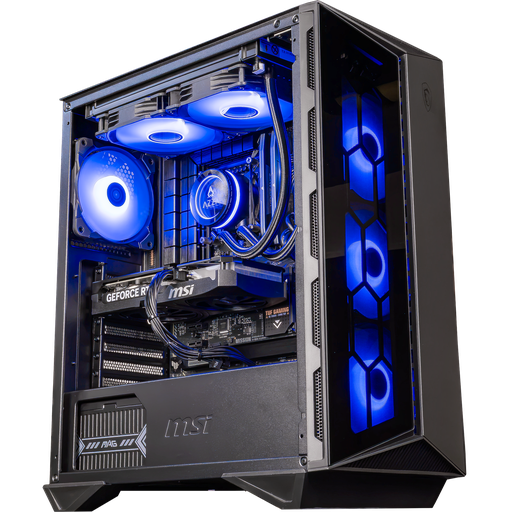
Swift PC: GeForce RTX 5060 Ti 16 GB
RTX 5060 Ti 16 GB, Core i5-14400F and 240 mm liquid cooling: DLSS 4 and ray tracing for 1440p.
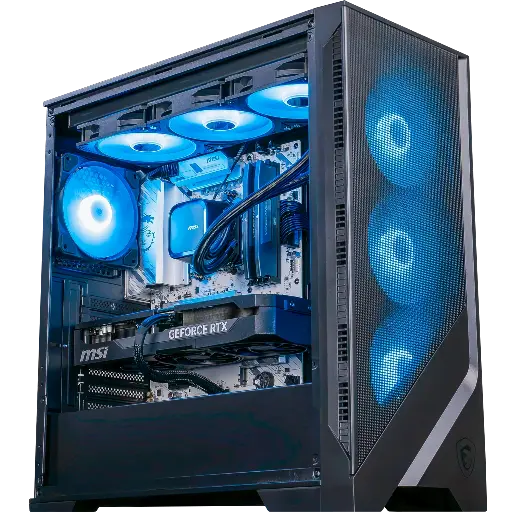
Requiem PC: RTX 5070 Ti and backup iGPU
RTX 5070 Ti 16 GB for gaming, and the Ryzen 7 9700X iGPU as a backup: 32 GB DDR5 and 360 mm water cooling.
FAQ: APU, iGPU and graphics card
What is an APU?
An AMD processor with a graphics section powerful enough to play lightweight games, like the Ryzen 7 8700G and its Radeon 780M.
What’s the difference between an APU and an iGPU?
The iGPU is the graphics chip integrated into the processor. The APU is a processor whose iGPU is strong enough to play games. The small chip in the Ryzen 9000 is an iGPU, not an APU.
Can you game with an APU?
Yes, on games that aren’t too demanding at 1080p with low settings. For newer games at high quality, a dedicated graphics card is required.
Does my processor have an iGPU?
On the AMD side, Ryzen 7000 and 9000 models without an F have one. Models ending in F (7500F, 8700F) and Intel KF models do not.
Where do you plug the screen into a gaming PC?
On the graphics card, at the bottom at the back of the case. The motherboard’s ports are only for the iGPU.
