
By the FlowUP team, gaming PC builder in Genappe (Belgium) · Updated 29 September 2026
In short: the PowerColor Red Devil RX 9070 XT is PowerColor’s flagship version of AMD’s Radeon RX 9070 XT, revealed in January 2025 and released with the card in March 2025. Under its more imposing cooling, you’ll find the RDNA 4 chip: 64 compute units, 16 GB of GDDR6 over a 256-bit bus and around 304 W. In games, an RX 9070 XT is on par with a RTX 5070 Ti in rasterisation (116.5 vs 116.8 FPS average at 1440p, according to Tom’s Hardware), for a lower launch price, and it also benefits from FSR 4. Custom versions like the Red Devil mainly add more silence and a bit more clock speed.
Red Devil, Hellhound, Reaper: PowerColor’s RX 9070 XT cards
PowerColor does not manufacture the chip: it designs the card around AMD’s GPU. For the RX 9000 generation, the brand rolls out the RX 9070 XT in several tiers, from the more restrained to the top-of-the-range. The Red Devil sits at the very top: a massive three-fan cooler, refined finishing with lighting, and boosted factory clocks.
The Hellhound and Reaper lines target a lower price or a more compact form factor. With virtually identical performance (it’s the same chip), the difference comes down to noise, temperatures, size and price. For the exact clock speeds and dimensions of each model, rely on PowerColor’s specifications: they vary from one version to another.
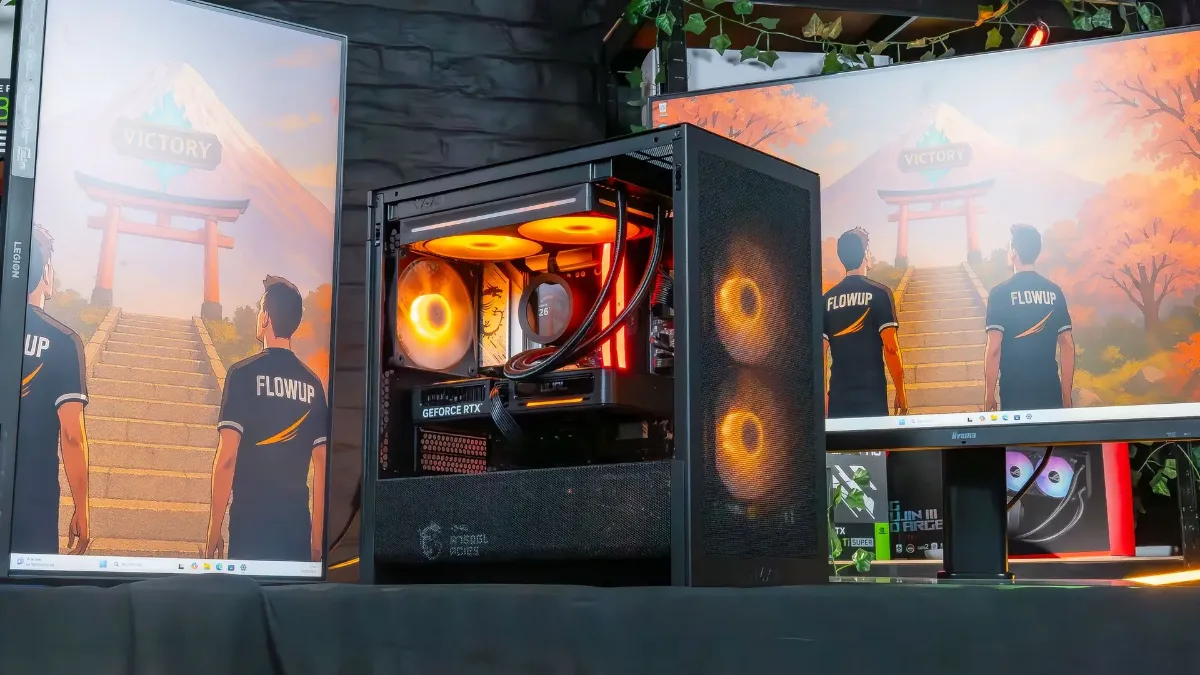
All the custom RX 9070 XT cards share the same chip: what changes is the cooling.
Radeon RX 9070 XT: key specifications
| Specification | RX 9070 XT | RX 9070 |
|---|---|---|
| Architecture | RDNA 4 | RDNA 4 |
| Compute units | 64 (4,096 stream processors) | 56 (3,584 stream processors) |
| Boost clock (AMD reference) | 2.97 GHz | 2.52 GHz |
| Video memory | 16 GB GDDR6, 256-bit, 640 GB/s | 16 GB GDDR6, 256-bit, 640 GB/s |
| Power consumption (TBP) | 304 W | 220 W |
| US launch price | $599 | $549 |
Source: Wikipedia, Radeon RX 9000 series (based on AMD specifications), consulted on 29 September 2026. Custom cards like the Red Devil have higher factory clocks.
Performance: RX 9070 XT vs RTX 5070 Ti
| Card (reference) | 1080p ultra | 1440p ultra | 4K ultra | US launch price |
|---|---|---|---|---|
| RX 9070 XT | 156.6 FPS | 116.5 FPS | 65.8 FPS | $599 |
| RTX 5070 Ti | 155.4 FPS | 116.8 FPS | 68.6 FPS | $749 |
| RX 9070 | 140.9 FPS | 104.0 FPS | 57.7 FPS | $549 |
| RTX 5070 | 132.6 FPS | 96.4 FPS | 54.3 FPS | $549 |
Source: Tom’s Hardware, graphics card ranking (average of 11 games in rasterisation, without upscaling), updated 24 June 2026 and consulted on 29 September 2026.
In rasterisation, the RX 9070 XT and the RTX 5070 Ti are tied, and the Radeon launched 150 dollars cheaper. The GeForce keeps the edge in heavy ray tracing and with DLSS, which is present in more games. For its part, AMD has made a big leap with the FSR 4, exclusive to Radeon RX 9000, which significantly improves the image quality of upscaling. We compare the two technologies in DLSS 4.5 vs FSR Redstone, and the AMD range in RX 9070 and RX 9070 XT.
Is the Red Devil worth the extra cost?
Our take as a PC builder: a high-end RX 9070 XT mainly brings you comfort. A bigger cooler spins more slowly, so it’s quieter, and it keeps the card cooler during long sessions. The FPS gain from factory clocks remains in the realm of a few percent.
- Choose a Red Devil if silence matters, if you have a large, well-ventilated case, and if the price gap stays reasonable.
- Choose a simpler version if your budget is tight: gaming performance will be almost identical.
- Check the size: high-end cards are long and thick. Measure the space in your case before buying.
- Plan your power supply: with around 304 W for the card, a good 750 to 850 W power supply is a safe choice. See how to choose your power supply.
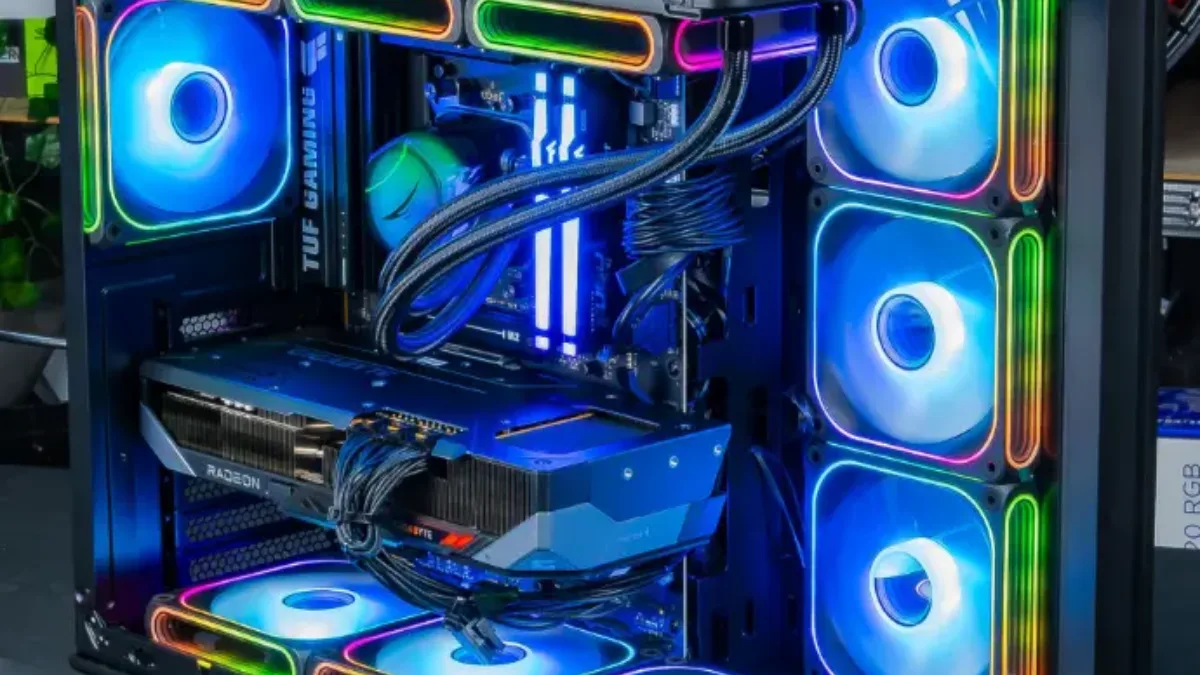
A high-end custom card is also chosen based on the case: length, thickness and cooling.
Our Radeon PCs
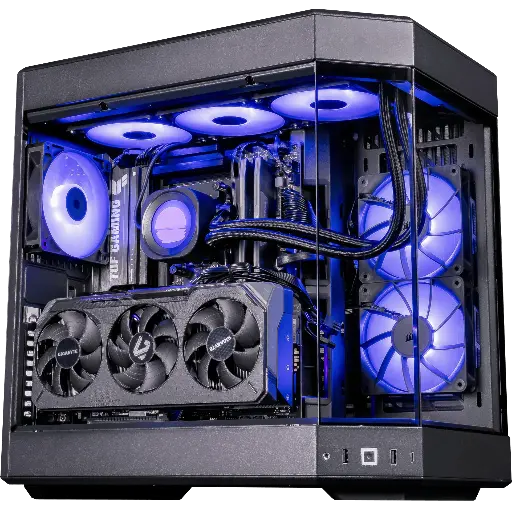
Shadow V2 PC: RX 9070 XT
Radeon RX 9070 XT 16 GB and Ryzen 7 9800X3D: the level of an RTX 5070 Ti in rasterisation, with FSR 4.
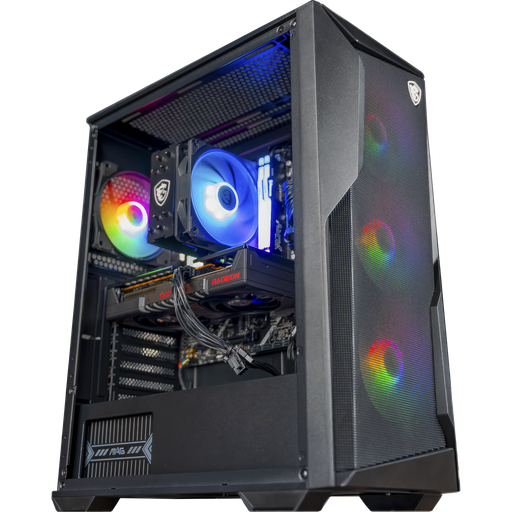
Rift PC: RX 9060 XT 16 GB
Ryzen 5 7500F, RX 9060 XT 16 GB and DDR5: entry into the RDNA 4 generation, in 1080p and 1440p.
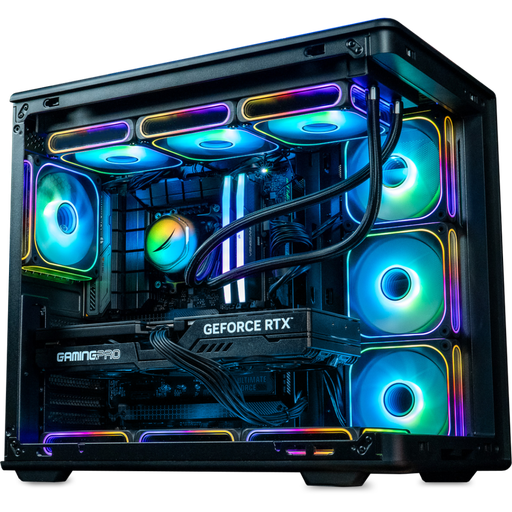
Rainbow V2 PC: the NVIDIA alternative
RTX 5070 Ti 16 GB: same rasterisation level, with DLSS 4 and sturdier ray tracing.
FAQ: PowerColor Red Devil RX 9070 XT
What’s the difference between the Red Devil and a standard RX 9070 XT?
Same chip, same memory. The Red Devil adds a bigger, more substantial cooling solution, a more refined design, and slightly higher factory frequencies: more silence and a few extra percent of performance.
Is the RX 9070 XT better than the RTX 5070 Ti?
Even in rasterisation (116.5 vs 116.8 FPS at 1440p on Tom's Hardware), for a lower launch price. The RTX 5070 Ti still comes out ahead in ray tracing and with DLSS.
How much memory does the RX 9070 XT have?
16 GB of GDDR6 on a 256-bit bus.
What power supply for an RX 9070 XT Red Devil?
The card draws about 304 W in reference form, a bit more for factory overclocked versions. A quality 750 to 850 W power supply leaves plenty of headroom; check the recommendation on the PowerColor spec sheet.
Does FSR 4 work on all Radeon cards?
No, it’s reserved for Radeon RX 9000 models, including the RX 9070 XT.
