 Your PC in instalments (up to 12x)
By the FlowUP team, PC assembler for gaming in Genappe (Belgium) · Updated 27 September 2026
Same launch price, same target, same focus on 1440p: the GeForce RTX 5070 and the Radeon RX 9070 go head to head for the same player. On paper, everything pits them against each other: 12 GB of GDDR7 on one side, 16 GB of GDDR6 on the other, DLSS 4 vs FSR 4. In games, the gap is much tighter than you might think.
We used the published benchmarks to tell you which one to choose depending on how you play. Good news: both are excellent cards, and we run both in our PCs.
In brief
- At 1440p, the RX 9070 is, on average, 8% ahead across 15 games, according to Tom's Hardware; at 1080p, the two cards are tied.
- In classic ray tracing, perfect tie at 1440p. The moment path tracing comes into play, the RTX 5070 takes the lead.
- The RTX 5070 has DLSS 4 with Multi Frame Generation and the NVENC encoder; the RX 9070 has 16 GB of memory and uses less power (220 W vs the 250 W stated).
- Our recommendation: RTX 5070 for path tracing, streaming, and DLSS 4; RX 9070 for rasterisation gaming and very demanding textures.
Table of contents
- RTX 5070 vs RX 9070: the specifications
- Gaming performance: who wins at 1440p?
- Ray tracing and path tracing
- DLSS 4 or FSR 4?
- RTX 5070 or RX 9070: which one should you choose?
- FAQ
RTX 5070 vs RX 9070: the specifications
Both cards were launched at the same recommended price of $549, according to Tom's Hardware. The RTX 5070 bets on faster GDDR7 memory; the RX 9070 on a larger amount of memory and lower power consumption.
| Specification | GeForce RTX 5070 | Radeon RX 9070 |
|---|---|---|
| Memory | 12 GB GDDR7 (28 Gbit/s) | 16 GB GDDR6 (20 Gbit/s) |
| Memory bus | 192 bits | 256 bits |
| Stated power consumption | 250 W | 220 W |
| Recommended power supply | 650 W | 650 W |
| Upscaling and image generation | DLSS 4 with Multi Frame Generation | FSR 4 |
| Launch price | $549 | $549 |
Sources: NVIDIA and AMD spec sheets, Tom's Hardware (May 2025).
Gaming performance: who wins at 1440p?
Tom's Hardware compared the two cards in 15 games. At 1080p, it’s a tie: a 0.33% difference in favour of the RX 9070. At 1440p, AMD’s card is 8.2% ahead on average, and 11% at 4K. Differences that are often down to just a few frames per second, well above 60 in most games.
Everything also depends on the game. The RX 9070 is 16% faster in Final Fantasy XVI and 31% in Microsoft Flight Simulator 2024; the RTX 5070 makes up 28% of the lead in Warhammer 40,000: Space Marine 2. If you have a favourite game, it should guide your choice.
| Benchmark (Tom's Hardware, 15 games) | Difference |
|---|---|
| Rasterisation at 1080p | Tie (0.33% for the RX 9070) |
| Rasterisation at 1440p | RX 9070 + 8.2% |
| Rasterisation at 4K | RX 9070 + 11% |
| Ray tracing at 1440p | Tie (0.23% for the RX 9070) |
| Warhammer 40,000: Space Marine 2 | RTX 5070 + 28.2% |
Ray tracing and path tracing
In classic ray tracing, the two cards are tied at 1440p according to Tom's Hardware: AMD has caught up with this generation. The difference comes down to path tracing, the most advanced form of ray tracing. Facing the higher-end RX 9070 XT, TechSpot measures the RTX 5070 as 32% faster in Doom: The Dark Ages at 1440p (September 2026). If you’re drawn to showcase titles like Cyberpunk 2077 in Overdrive mode, the RTX 5070 is the right choice.
To understand what these modes change in image quality, we explained everything in our article ray tracing c'est quoi.
DLSS 4 or FSR 4?
Both cards feature next-generation AI upscaling: DLSS 4 on the NVIDIA side, FSR 4 on the AMD side. Tom's Hardware gives NVIDIA the software edge, and DLSS 4’s Multi Frame Generation remains an exclusive feature of the GeForce RTX 50 series: it generates multiple images between two calculated frames, an undeniable plus on a high-refresh-rate display.
FSR 4 represents a major step forward for AMD in image quality. For the details of both technologies, our article DLSS 4.5 vs FSR Redstone compares their settings.
RTX 5070 or RX 9070: which one should you choose?
As 1440p graphics cards, both are excellent choices: what should decide is how you’ll use them.
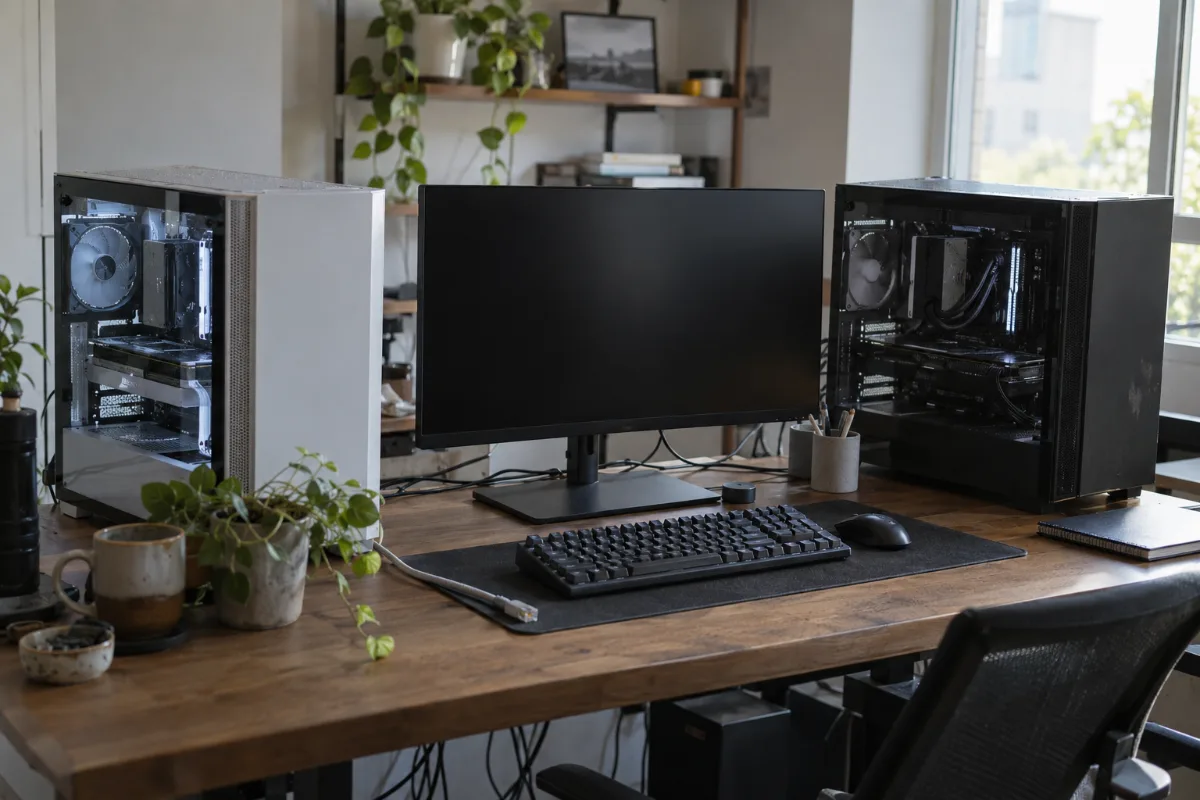
The workshop’s verdict
Choose the RTX 5070 if you play games with path tracing, if you stream (the NVENC encoder is a reference) or if you want the DLSS 4 Multi Frame Generation. Choose the RX 9070 if you mainly game in rasterisation, in titles that are very demanding on textures, and if its 16 GB memory gives you peace of mind for the years ahead.
Here are the ones we’re building right now in Genappe:
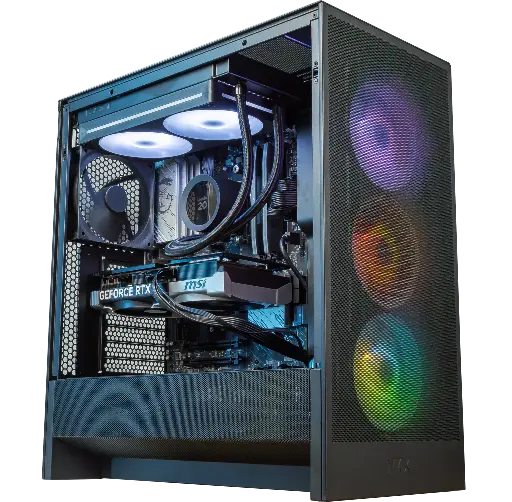
Velaris PC GeForce RTX 5070
The RTX 5070 with a Ryzen 5 7500X3D, perfect for gaming in 1440p with DLSS 4 and path tracing.
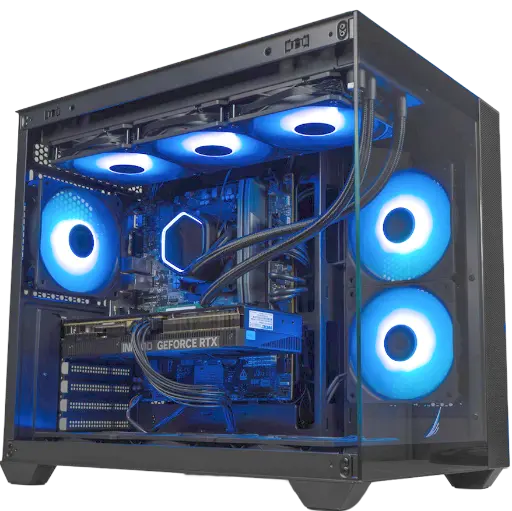
Umbra PC GeForce RTX 5070
The RTX 5070 with a Ryzen 5 7500F: the most direct way to move up to 1440p.
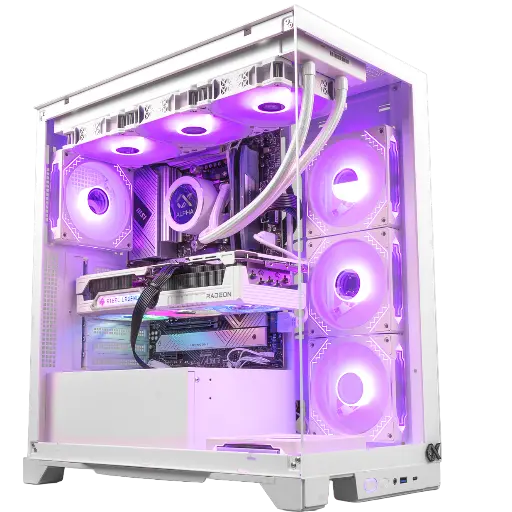
Sakura PC Radeon RX 9070 White
The RX 9070 and its 16 GB with a Ryzen 7 8700F, in a white case.
To go further: our full review of the RTX 5070, our reviews of the RX 9070 and RX 9070 XT, or all our gaming PCs.
FAQ RTX 5070 vs RX 9070
RX 9070 vs RTX 5070: which is faster?
In rasterisation, the RX 9070 is 8.2% faster on average in 1440p, according to Tom's Hardware. In classic ray tracing, they’re tied; in path tracing, the RTX 5070 takes the lead.
RTX 5070 or RX 9070 for streaming?
The RTX 5070: NVIDIA’s NVENC encoder is the benchmark for streaming while you game.
12 GB or 16 GB of memory, what difference does it make?
In 1440p, the 12 GB of the RTX 5070 are enough for the vast majority of games, and its GDDR7 is faster. The 16 GB of the RX 9070 provide extra headroom in games with the heaviest textures. We break down the question in our article 8 GB, 12 GB or 16 GB of VRAM.
What power supply for an RTX 5070 or an RX 9070?
NVIDIA and AMD both recommend a 650 W power supply for the full PC.
