
By the FlowUP team, gaming PC builder in Genappe (Belgium) · Updated 29 September 2026
In brief: Blackwell is NVIDIA’s graphics card architecture that powers the GeForce RTX 50, from the RTX 5050 to the RTX 5090, released between January and July 2025. Its main new features: 5th-generation Tensor cores capable of computing in FP4 (enabling the DLSS 4 Multi Frame Generation), 4th-generation RT cores designed for highly detailed geometry (Mega Geometry), GDDR7 memory, PCIe 5.0 and DisplayPort 2.1b. The same name also refers to the AI chips for data centres (B200, B300), which have nothing to do with your gaming PC. Some January 2025 promises, such as Reflex 2 and neural texture compression, were still not available in games by September 2026.
Blackwell: what exactly are we talking about?
At NVIDIA, each graphics card generation is named after a scientist: Ampere for the RTX 30, Ada Lovelace for the RTX 40, and Blackwell, in tribute to mathematician David Blackwell, for the RTX 50.
Small source of confusion: NVIDIA uses the same name for two very different families of chips. The GeForce RTX 50 for gamers and creators, and the B200, GB200 and B300 (Blackwell Ultra) for AI servers. They share ideas, but not the same chip. This article is about the GeForce version.
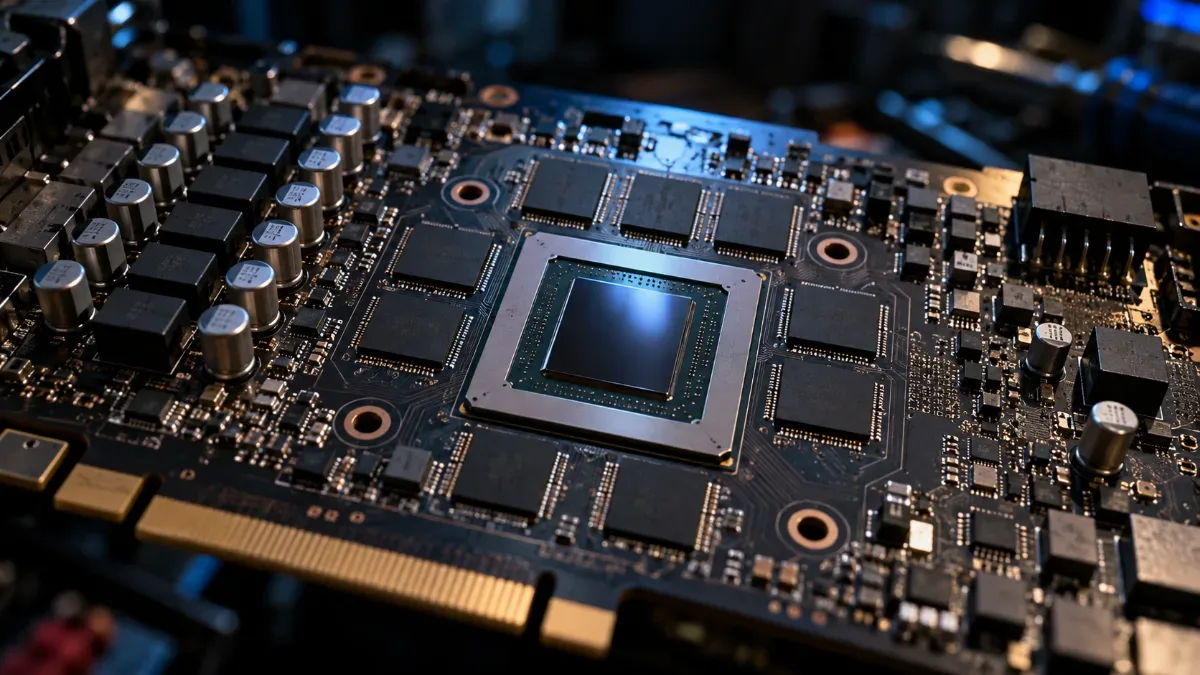
In the centre, the graphics chip; around it, the GDDR7 video memory modules.
What changes in the chip
| Item | New feature | Why it matters |
|---|---|---|
| Manufacturing process | TSMC 4N (NVIDIA custom process) | The same manufacturing process family as the RTX 40: the gains come from the architecture, not a finer process |
| 5th-generation Tensor cores | FP4 computation | Doubles AI throughput and halves the required memory, according to NVIDIA: this is what enables Multi Frame Generation |
| 4th-generation RT cores | Triangle cluster intersection engine | Speeds up ray tracing in very detailed scenes (Mega Geometry) |
| Compute cores | Unified INT32 and FP32 units | More flexibility for shaders, including neural shaders |
| Memory | GDDR7 (except RTX 5050 in GDDR6) | More bandwidth than GDDR6X |
| Connections | PCIe 5.0, DisplayPort 2.1b | Up to 4K at 480 Hz or 8K at 165 Hz |
| 9th-generation NVENC video encoder | H.264 and HEVC at 4:2:2 | Useful for video editing with files from recent cameras |
| AMP processor and Flip Metering | AI workload management and display timing | Essential so that generated images are displayed at regular intervals |
Source: NVIDIA, white paper on the RTX Blackwell architecture. The largest chip, the GB202 of the RTX 5090, has 92.2 billion transistors on 750 mm².
DLSS 4 and Multi Frame Generation: the real change for gamers
The most visible new feature of Blackwell is Multi Frame Generation. Where the RTX 40 generated an image between two computed frames, the RTX 50 can generate up to three images using DLSS 4, and then up to five with DLSS 4.5 and its 6X mode (March 2026). At CES 2025, NVIDIA announced performance multiplied by over 8 in a Cyberpunk 2077 scene on RTX 5090, combining upscaling and image generation.
That figure should be read with caution. Generated images make the display look smoother, but don’t make the game more responsive: latency still depends on the frames that are actually computed. Our view: Multi Frame Generation is excellent for enjoying a 240 Hz screen in single-player when you already have a baseline of at least 60 FPS; much less useful in competitive play. We break down the versions and settings in DLSS 4.5 versus FSR Redstone and FSR 4.1.
Les Numériques tested the RTX 5080 at launch, with a good preview of what DLSS 4 changes:
Les Numériques, “Test of the Nvidia RTX 5080: saved by DLSS 4!”, January 2025.
Kept promises, pending promises
In January 2025, NVIDIA unveiled several technologies related to Blackwell. Twenty months later, the verdict is mixed:
| Technology | Status as of 29 September 2026 | Detail |
|---|---|---|
| Multi Frame Generation (DLSS 4) | Available | Since the launch of the RTX 50, expanded to 6X mode in March 2026 |
| RTX Mega Geometry | Available in a few games | First game: Alan Wake 2 (update dated 31 January 2025), path tracing 15 to 20% faster |
| Reflex 2 with Frame Warp | Still not available | Announced for The Finals and Valorant, but no game was using it by the end of July 2026 |
| Neural texture compression (NTC) | Development kit in beta | Beta version 0.10 in September 2026; no commercial game uses it yet |
| 4:2:2 encoding | Available | Supported in compatible video editing software |
Sources: NVIDIA, TweakTown, Hardware Busters (July 2026), RTXNTC GitHub repository and Wccftech (September 2026).
The GeForce RTX 50 range
All RTX 50 desktop cards use the Blackwell architecture. The prices below are US launch prices, in dollars and before tax: they’re meant to place each card within the range, not to estimate what you’ll pay today.
The choice depends mostly on your screen and video memory: 8 GB is getting tight in some recent games, which is why we recommend the RTX 5060 Ti with 16 GB rather than the 8 GB model. Everything is explained in RTX 5060 or RTX 5060 Ti: 8 or 16 GB.
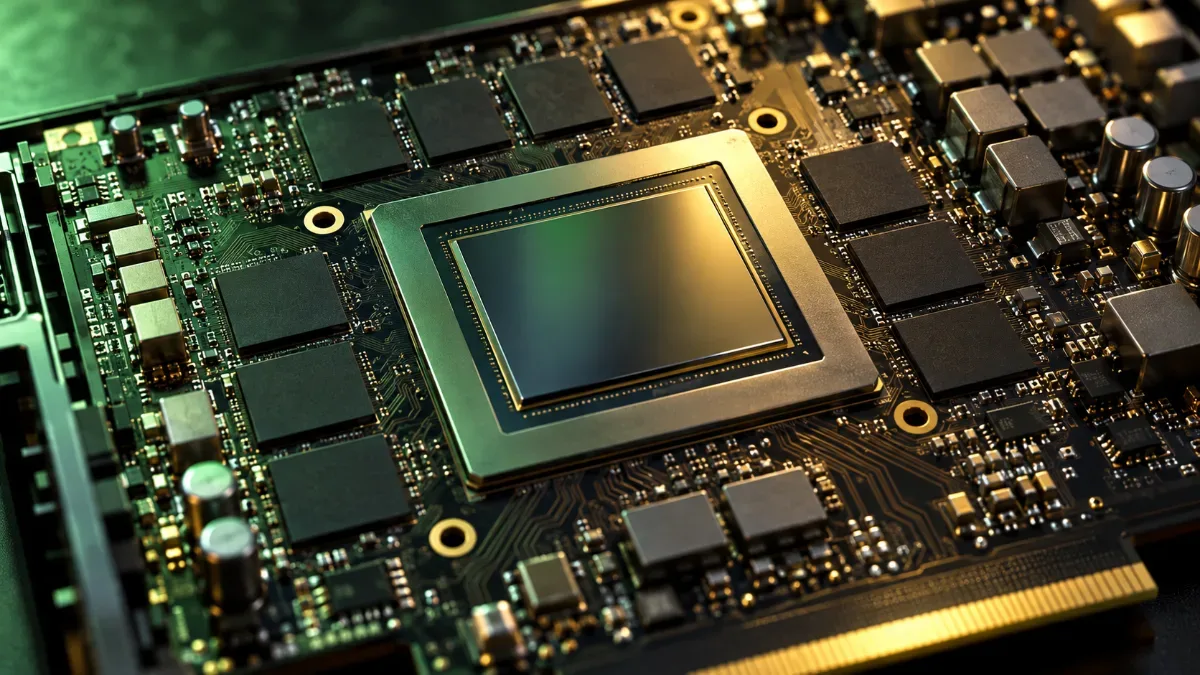
GDDR7 is one of the main hardware upgrades of the RTX 50.
| Card | CUDA cores | Memory | Launch price (United States) | Release |
|---|---|---|---|---|
| RTX 5090 | 21,760 | 32 GB GDDR7 | $1,999 | January 2025 |
| RTX 5080 | 10,752 | 16 GB GDDR7 | $999 | January 2025 |
| RTX 5070 Ti | 8,960 | 16 GB GDDR7 | $749 | February 2025 |
| RTX 5070 | 6,144 | 12 GB GDDR7 | $549 | March 2025 |
| RTX 5060 Ti | 4,608 | 16 or 8 GB GDDR7 | $429 or $379 | April 2025 |
| RTX 5060 | 3,840 | 8 GB GDDR7 | $299 | May 2025 |
| RTX 5050 | 2,560 | 8 GB GDDR6 | $249 | July 2025 |
Sources: NVIDIA (press releases and product sheets), Tom's Hardware, TweakTown.
And what next? The RTX 50 Super models never materialised: according to The Information (February 2026), their launch was pushed back with no date set due to a memory shortage, with NVIDIA only saying that memory supply was constrained. On the data-centre side, the next generation, Vera Rubin, entered production in 2026. We’re covering the story in RTX 50 Super: where are we at?.
Our Blackwell gaming PCs
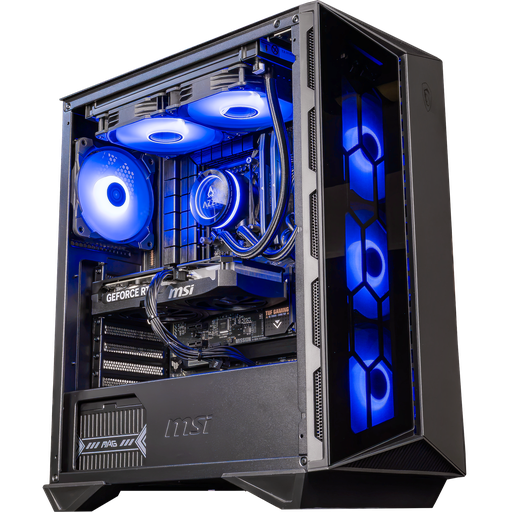
Swift PC: RTX 5060 Ti 16 GB
The 16 GB version of the RTX 5060 Ti, to make the most of DLSS 4 and Multi Frame Generation at 1080p and 1440p.
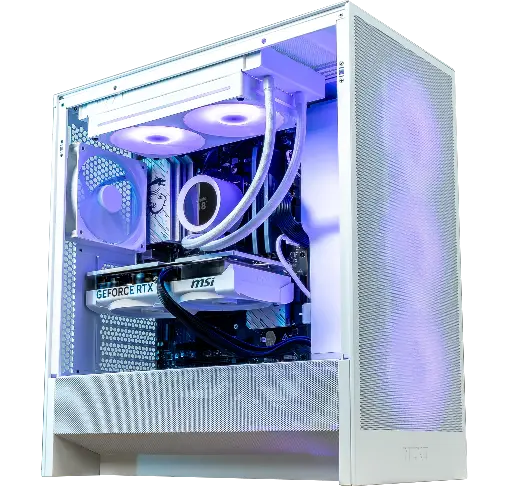
Novara PC: RTX 5070 and X3D
RTX 5070 and Ryzen 5 7500X3D: 1440p with DLSS 4, plus a 3D-cache processor for steady FPS.
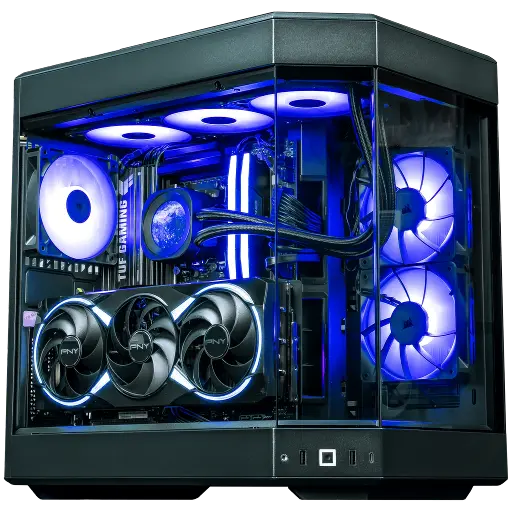
Orion PC: RTX 5080 for 4K
RTX 5080 and Ryzen 7 X3D: 4K with ray tracing and Multi Frame Generation.
Before installing an RTX 50 in an existing PC, check the power supply and the case: our guide RTX 5000: what power supply, which case, and which motherboard? takes a look.
FAQ: Blackwell architecture
What is NVIDIA Blackwell architecture?
It’s the generation of NVIDIA graphics chips that succeeds Ada Lovelace (RTX 40). It powers the GeForce RTX 50 and, in another form, the B200 and B300 AI accelerators.
Which cards use Blackwell?
All desktop GeForce RTX 50 cards: RTX 5050, 5060, 5060 Ti, 5070, 5070 Ti, 5080 and 5090, as well as the RTX 50 for laptops.
What’s the difference between Blackwell and Ada Lovelace?
Tensor cores capable of computing in FP4, enabling Multi Frame Generation; RT cores optimised for complex geometry; GDDR7; PCIe 5.0; and DisplayPort 2.1b. The fabrication process remains within the same family.
Does Multi Frame Generation work on the RTX 40?
No. The RTX 40 generate a single intermediate frame; multi frame generation is reserved for the RTX 50.
Is Reflex 2 available?
Not yet as of 29 September 2026: no game used Frame Warp in late July 2026, and NVIDIA still lists it as “coming soon”.
Sources
- NVIDIA, RTX Blackwell architecture white paper
- NVIDIA, announces GeForce RTX 50 (January 2025)
- NVIDIA, DLSS 4 and Multi Frame Generation
- Tom's Hardware, RTX 5060 Ti and RTX 5060 (2025)
- NVIDIA, GeForce RTX 5050
- TweakTown, Alan Wake 2 and RTX Mega Geometry (January 2025)
- Hardware Busters, Reflex 2 still missing (July 2026)
- NVIDIA, RTX Neural Texture Compression repository
- Tom's Hardware, report on RTX 50 Super claims from The Information (February 2026)
- NVIDIA, financial results for Q2 of fiscal 2027 (August 2026)
