
By the FlowUP team, gaming PC builder in Genappe (Belgium) · Updated 29 September 2026
In brief: Fortnite runs on almost anything, but not in the same way. To play competitively (1080p, Performance mode, 240 FPS and up), the priority is the processor: a Ryzen X3D or a good recent 6-core CPU, paired with a mid-range graphics card. To enjoy Epic graphics (Lumen, Nanite, ray tracing) at 1440p, it’s the graphics card that matters: aim for at least the level of the official Epic presets (RTX 3070 or RX 6700 XT), and ideally an RTX 5070 or RX 9070 XT. In any case: 16GB RAM, an NVMe SSD, and 64-bit Windows 10 or 11.
One game, two ways to play
Fortnite has a special trait: depending on the rendering mode, it’s both one of the lightest games on the market and one of the prettiest. In Performance mode, it runs on modest PCs and scales up to hundreds of frames per second. In DirectX 12 with Epic settings, it enables Lumen (global illumination), Nanite (ultra-detailed geometry) and hardware ray tracing, making it noticeably more demanding.
So the right setup depends first on one question: are you playing to win, or to be wowed by the visuals?
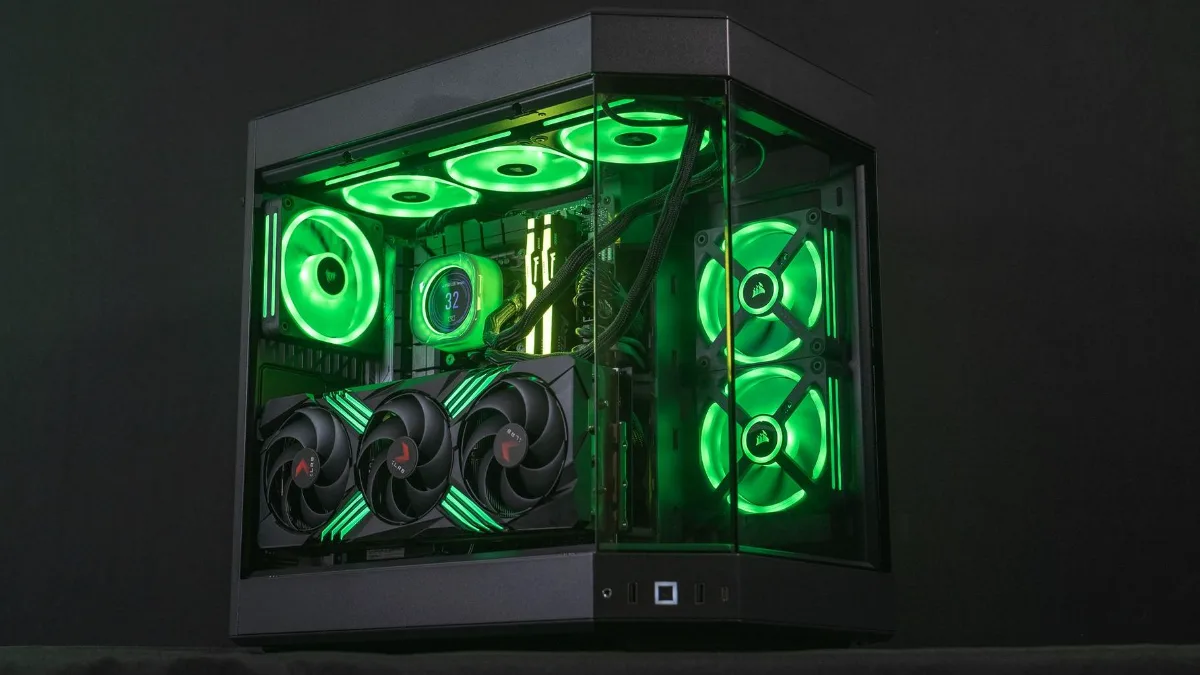
A well-balanced gaming PC runs Fortnite competitively as well as in Epic quality.
Fortnite official system requirements
| Component | Minimum | Recommended | Epic presets |
|---|---|---|---|
| Processor | Core i3-3225 3.3 GHz | Core i5-7300U 3.5 GHz or Ryzen 3 3300U | Core i7-8700 or Ryzen 7 3700X |
| Graphics card | Intel HD 4000 or Radeon Vega 8 | GTX 960 or R9 280 | RTX 3070 or RX 6700 XT |
| Video memory | Not specified | 2 GB | 8 GB or more |
| RAM | 8 GB | 16 GB or more | 16 GB or more |
| System | Windows 10 22H2 64-bit | Windows 10 or 11 64-bit | Windows 10 or 11 64-bit |
| Storage | Not specified | NVMe SSD | NVMe SSD |
Source: Epic Games, Fortnite PC system requirements (accessed 29 September 2026).
Two notes. Epic’s “minimum” is the game that launches, not the pleasant-to-play one. And since the April 2026 update 40.10, the DirectX 11 option is gone: Performance mode and DirectX 12 remain, which Epic says were optimised in that update.
For competitive play: it’s the processor that matters
Pro players play at 1080p, in Performance mode, on 240 Hz, or even 360 Hz screens. That’s what ProSettings’ analysis shows on 339 professional players (January 2026). At those refresh rates, the graphics card is no longer the limiting factor. In TechSpot’s RTX 5070 Ti vs RX 9070 XT test, both cards exceed 720 FPS at 1440p in Performance mode, and the site concludes that the limit is imposed by the processor.
In practice, for competitive play it’s the processor that holds the FPS in the late, heavy parts of matches, where everyone builds at the same time. Ryzen X3D CPUs, which are very comfortable in processor-limited games, are the natural choice. An RTX 5060, an RX 9060 XT, or better is enough on the graphics side. Enable NVIDIA Reflex if your card supports it: Fortnite supports it to reduce latency.
Podasai details the settings used by competitive players, graphics included:
Podasai, “The best Fortnite settings to become a pro player (#2)”, November 2025. Filmed before the removal of DirectX 11 in April 2026.
For Epic graphics: it’s the graphics card
In DirectX 12 with Lumen and ray tracing, the workload shifts to the graphics card. A few published measurements:
| Graphics card | Average FPS | Settings | Source |
|---|---|---|---|
| RTX 3060 | 78.8 FPS | 1080p, High preset (Lumen High), DLSS/TSR Quality | ComputerBase, April 2024 |
| RTX 4060 | 94.9 FPS | 1080p, High preset (Lumen High), DLSS/TSR Quality | ComputerBase, April 2024 |
| RTX 4070 | 137.8 FPS | 1080p, High preset (Lumen High), DLSS/TSR Quality | ComputerBase, April 2024 |
| RTX 5060 Ti 16 GB | 78 FPS | 1440p, Epic quality with ray tracing | TechSpot, 2026 |
| RX 9070 XT | 120 FPS | 1440p, Epic quality with ray tracing | TechSpot, 2026 |
The tests don’t use the same settings or the same processors: compare the cards within the same source. ComputerBase considers the game comfortable from 80 FPS, ideally 90.
Our take: for 1440p in Epic quality, a RTX 5070 or a RX 9070 XT is the right balance point. Fortnite has native DLSS 4 support since spring 2026 (but not frame generation), which helps NVIDIA cards keep some headroom.
Which PC for Fortnite, depending on your profile
| Your profile | Recommended setup | Settings |
|---|---|---|
| Casual player, 1080p 60 to 144 Hz | Recent 6-core processor, RTX 5060 or RX 9060 XT, 16 GB | Performance mode or DX12 with medium to high settings |
| Competitive, 1080p 240 Hz and up | Ryzen X3D or fast recent 6-core, RX 9060 XT to RTX 5070, 16 to 32 GB | Performance mode, Reflex enabled |
| Epic quality at 1440p | RTX 5070 or RX 9070 XT, 32 GB | DX12, Lumen, DLSS or FSR in Quality |
| 4K or maximum ray tracing | RTX 5070 Ti, RTX 5080 or RX 9070 XT | DX12, upscaling in Quality or Balanced mode |
The processor also counts for streaming while gaming; for the rest of the build (PSU, cooling, case), follow our guide How to choose your gaming PC in 2026and to pair the processor with the graphics card, our selection of the best processor and graphics card combos.
Our PCs for playing Fortnite
Each PC is assembled and tested before shipping, and each product page lists the expected FPS in popular games. Here are the ones we recommend for Fortnite, from competitive to Epic quality.
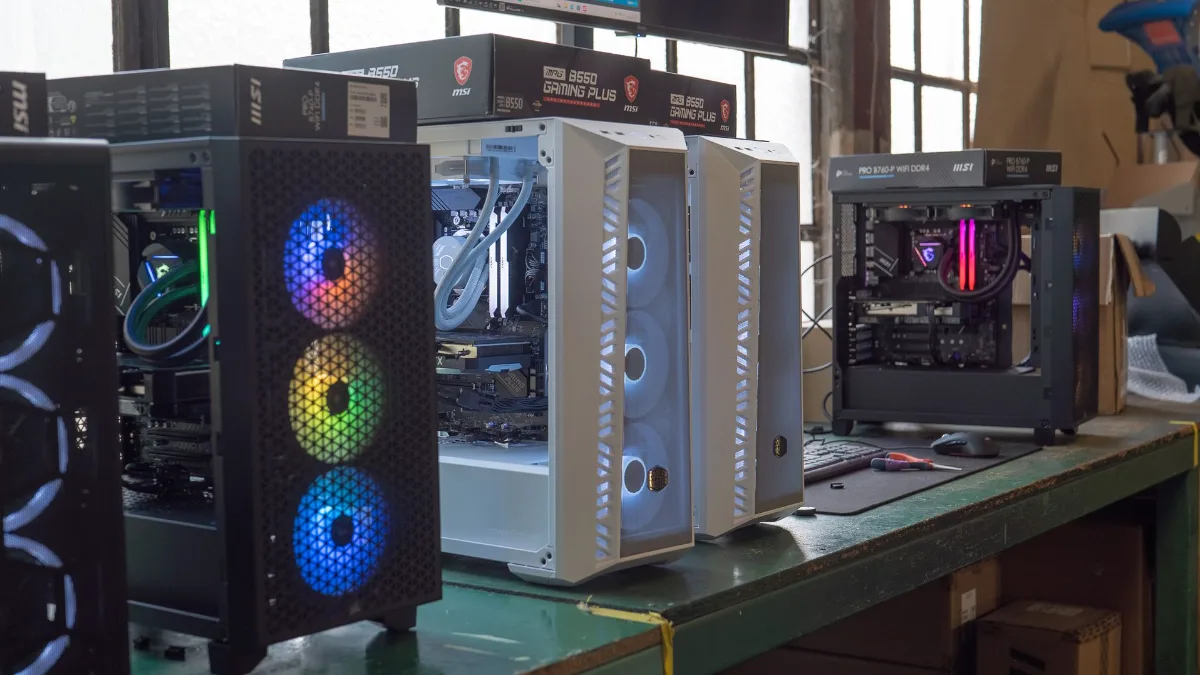
Our PCs in the testing phase in the workshop.
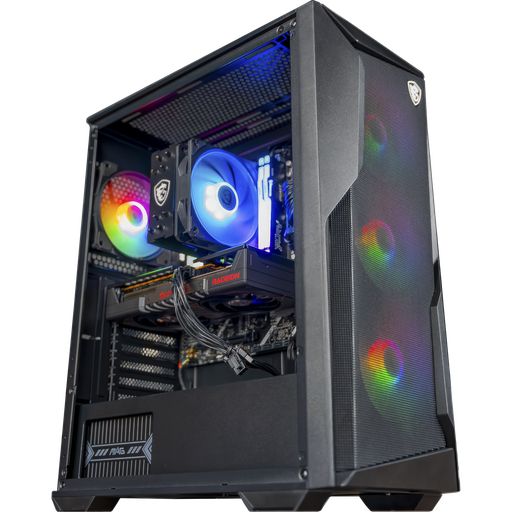
Rift PC: entry-level for competitive play
Ryzen 5 7500F, RX 9060 XT 16 GB and 16 GB DDR5 on the AM5 platform: enough to target a high-refresh-rate screen in 1080p.
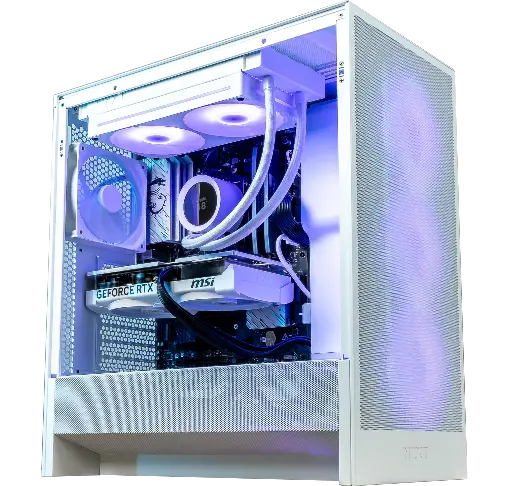
Novara PC: the X3D for high FPS
Ryzen 5 7500X3D, RTX 5070 and 16 GB DDR5: the 3D cache for intense battles, plus Reflex and DLSS 4 on the NVIDIA side.

PC Novara GeForce RTX 5070 12GB
Ryzen 5 7500X3D, RTX 5070 12GB, 16 GB DDR5 and 1 TB M.2 SSD: a ready-to-play setup straight out of the box.
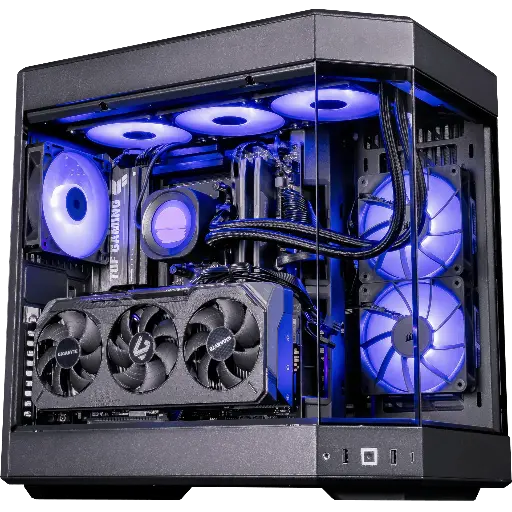
Shadow V2 PC: Epic quality in 1440p and 4K
Ryzen 7 9800X3D, RX 9070 XT 16 GB and 32 GB DDR5 for Lumen and ray tracing.
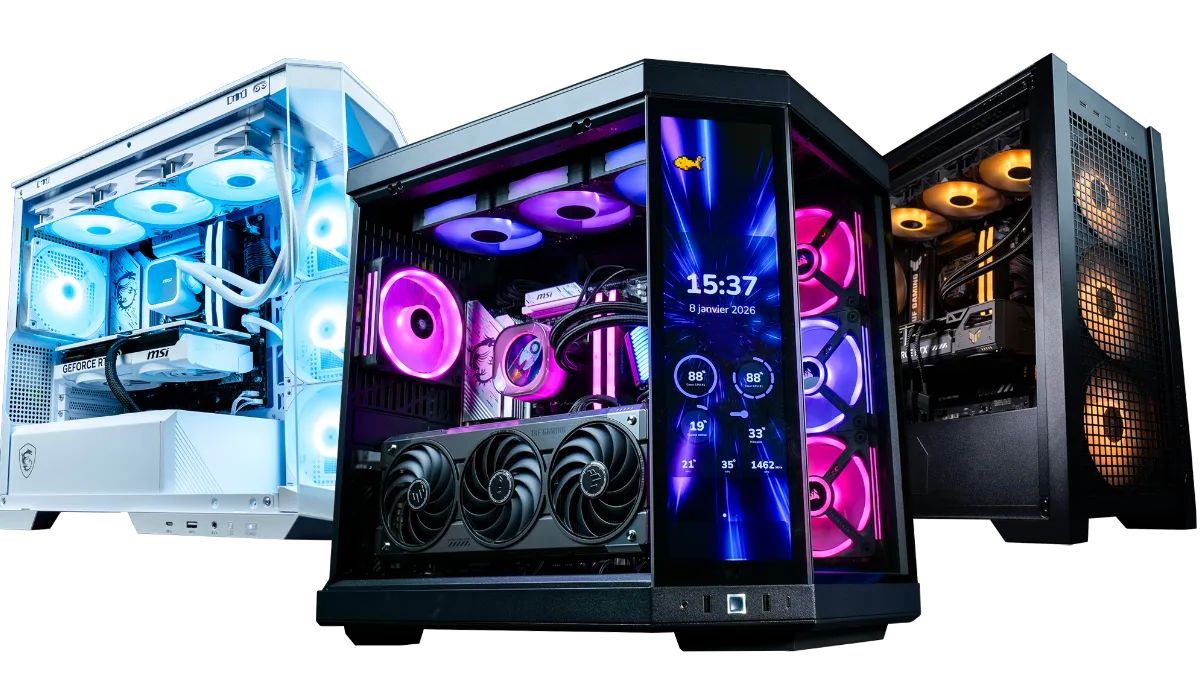
The whole range is in the category FlowUP gaming PC.
FAQ: PC for Fortnite
What minimum configuration do you need to play Fortnite?
Officially, a Core i3-3225, an Intel HD 4000 or Radeon Vega 8, and 8 GB of RAM on Windows 10 64-bit. In practice, aim for at least the recommended setup (16 GB RAM, NVMe SSD) for smooth gameplay.
How many FPS do you need for Fortnite?
60 FPS for casual play, 144 FPS and up to build comfortably, 240 FPS and up in competitive, provided you have a monitor that can keep up.
Does Fortnite depend more on the processor or the graphics card?
In Performance mode and at very high FPS: the processor. In DirectX 12 with Lumen and ray tracing: the graphics card.
Can you still play Fortnite in DirectX 11?
No. Epic removed the DirectX 11 option with update 40.10 in April 2026; you still have Performance mode and DirectX 12.
Does Fortnite support DLSS 4?
Yes, natively since spring 2026, along with DLAA. Frame generation is not offered in the game.
16 or 32 GB of RAM for Fortnite?
16 GB is enough for playing the game on its own. 32 GB becomes useful if you stream, record, or keep many applications open. Details in 16 or 32 GB of RAM in 2026.
Sources
- Epic Games, system requirements for Fortnite on PC
- Epic Games, removal of the DirectX 11 option (2026)
- ComputerBase, Fortnite benchmark (April 2024)
- TechSpot, RX 9070 XT vs RTX 5060 Ti 16 GB (2026)
- TechSpot, RTX 5070 Ti vs RX 9070 XT
- ProSettings, monitors used by pro Fortnite players (January 2026)
- PC Guide, native DLSS 4 in Fortnite (April 2026)
- NVIDIA, Reflex-compatible games
