 Your PC in instalments (up to 12x)
By the FlowUP team, gaming PC builder in Genappe (Belgium) · Updated 30 September 2026
In brief: a gaming PC’s power consumption depends mainly on its graphics card and processor. In games, a mid-range setup (RX 9060 XT and Ryzen 5 7500F) uses around 225 W for these two components, compared with nearly 750 W for an RTX 5090 with a Ryzen 9. At €0.20 per kWh (EDF Tarif Bleu, August 2026) and 3 hours of gaming per day, that works out to about €50 per year for the first and €165 per year for the second, at most.
How much does a gaming PC use?
A PC doesn’t consume a fixed amount. On the Windows desktop, it only idles at a few tens of watts. While gaming, the graphics card and the processor are pushed harder and power draw rises. So it’s the power of these two components that determines most of the bill.
The motherboard, RAM, SSDs and fans add a few tens of watts. The monitor is counted separately.
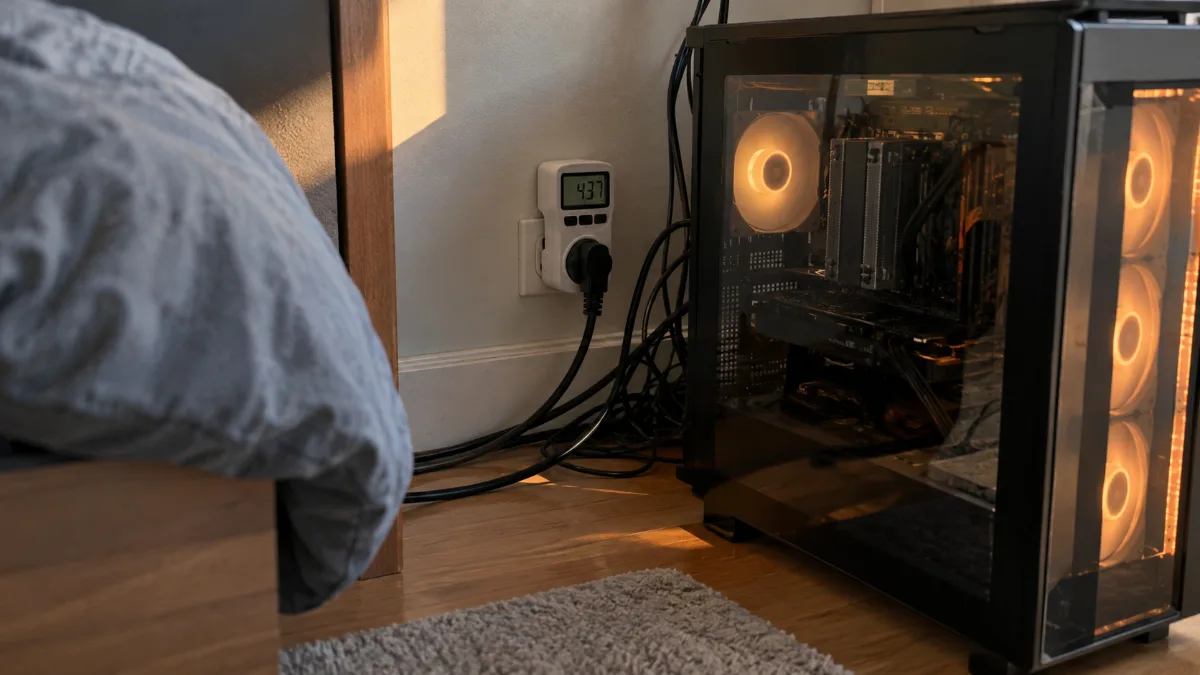
A wattmeter on the socket: the simplest way to know your PC’s actual power consumption.
Power consumption of graphics cards and processors
| Graphics card | Card power | Recommended power supply |
|---|---|---|
| GeForce RTX 5060 | 145 W | 550 W |
| GeForce RTX 5060 Ti | 180 W | 600 W |
| GeForce RTX 5070 | 250 W | 650 W |
| GeForce RTX 5070 Ti | 300 W | 750 W |
| GeForce RTX 5080 | 360 W | 850 W |
| GeForce RTX 5090 | 575 W | 1 000 W |
| Radeon RX 9060 XT | 160 W | 450 W |
| Radeon RX 9070 | 220 W | 650 W |
| Radeon RX 9070 XT | 304 W | 750 W |
Sources: NVIDIA and AMD, official datasheets (total board power).
On the CPU side, AMD states 65 W for the Ryzen 5 7500F and 120 W for the Ryzen 7 7800X3D and 9800X3D. Intel gives 65 W as base power and 148 W in turbo for the Core i5-14400F, and up to 250 W for the Core Ultra 7 265KF. In games, a processor is often far from these maximums, because the graphics card does most of the work.
These figures are maximums. In practice, Tom’s Hardware measured an average of about 242 W for an RTX 5070 in 4K, and KitGuru 242 W for an RTX 5080 in 1080p, well below its stated 360 W.
How much does a gaming PC cost in electricity?
The calculation is simple: power in kW × hours of gaming × the price per kWh. Here’s an estimate for 3 hours of gaming per day all year round, by adding the maximum power of the graphics card and the processor for four FlowUP configurations.
| Configuration | Graphics card + processor (max.) | Per year (3 h/day) | Annual cost at €0.20/kWh |
|---|---|---|---|
| Rift PC: RX 9060 XT + Ryzen 5 7500F | 225 W | 246 kWh | about €49 |
| Swift PC: RTX 5060 Ti + Core i5-14400F | 328 W | 359 kWh | about €72 |
| Cheetoh PC: RTX 5070 + Ryzen 7 7800X3D | 370 W | 405 kWh | about €81 |
| Kraken PC: RTX 5090 + Ryzen 9 9950X3D | 745 W | 816 kWh | about €163 |
FlowUP calculation based on official NVIDIA, AMD and Intel power figures, and the EDF Tarif Bleu base-option rate of €0.2001 per kWh incl. VAT as of 1 August 2026 (CRE deliberation of 15 July 2026). High estimate: in real gaming, consumption is often lower.
So even a very high-end PC stays under €15 per month with 3 hours of gaming per day. The gap widens mainly for those who game a lot, or who leave the PC running for hours for renders.
Which power supply should you choose based on consumption?
The power supply must cover the maximum power draw with some headroom, because recent graphics cards have very short spikes above their rated power. Follow the recommended value from the graphics card manufacturer (table above), and prefer an 80 Plus Gold certification: it loses less energy as heat. Everything is detailed in how to choose your PC power supply, and the spikes are explained in our article on ATX 3.0 and ATX 3.1.
How to reduce your gaming PC’s power consumption
- Limit the frames per second to your screen’s refresh rate: the graphics card won’t calculate unnecessary frames. VRR also helps, as explained in FreeSync or G-Sync.
- Enable DLSS or FSR: lower internal rendering reduces the graphics card’s load.
- Turn off the PC rather than leaving it on overnight, and enable screen sleep.
- Keep the PC clean: a dusty PC gets hotter, its fans spin faster and components lose efficiency.
Our builder's take: the first setting to change is the limit on frames per second. On a 144 Hz screen, running a game at 300 frames per second is pointless, and it adds extra power draw.

Limit frames per second: the simplest setting to reduce power consumption.
To check that your current power supply can handle the load, read how to tell if your PC power supply is sufficient.
Our gaming PCs, from the most power-efficient to the most powerful
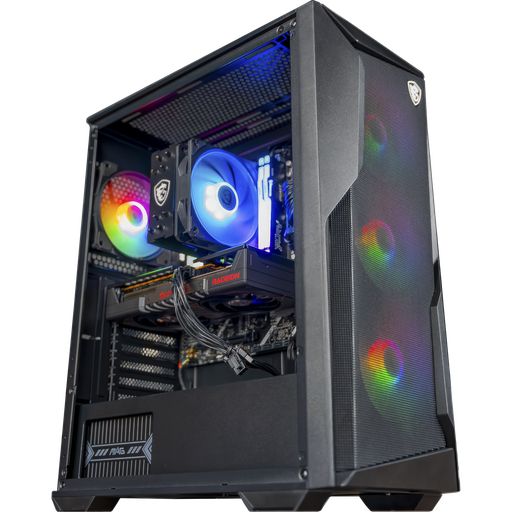
Rift PC: the most power-efficient
RX 9060 XT 16 GB (160 W) and Ryzen 5 7500F (65 W): 1080p and 1440p with controlled power draw.
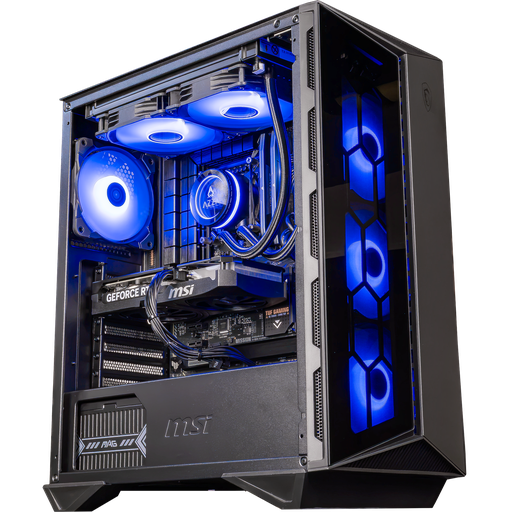
Swift PC: the balance
RTX 5060 Ti 16 GB (180 W) and Core i5-14400F: a good performance-per-watt ratio in 1080p and 1440p.
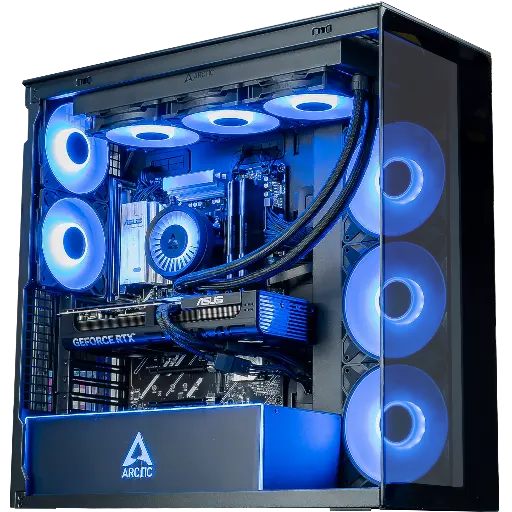
Cheetoh PC: efficient 1440p
RTX 5070 (250 W) and Ryzen 7 7800X3D (120 W): 1440p on ultra settings, without sending the bill soaring.
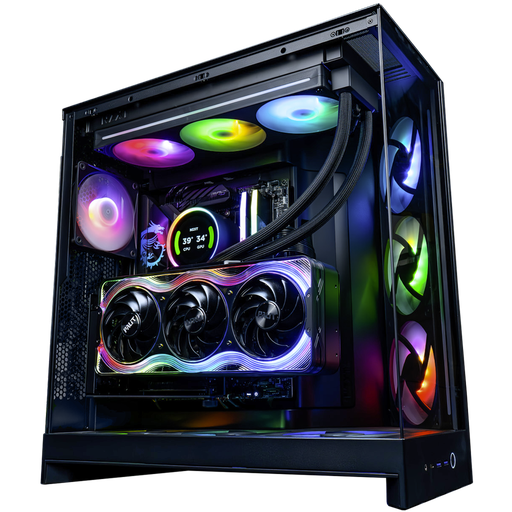
Kraken PC: maximum power
RTX 5090 32 GB and Ryzen 9 9950X3D, with a 1200 W ATX 3.1 power supply: 4K without compromise.
FAQ: power consumption of a gaming PC
How much does a gaming PC use per hour?
In-game, from 0.2 to 0.75 kWh per hour depending on the setup, by adding the maximum power of the graphics card and the processor. In idle, much less.
How much does a gaming PC cost in electricity per year?
For 3 hours of gaming per day at €0.20/kWh: about €50 for a mid-range setup, and up to €165 for an RTX 5090, at most.
Which graphics card uses the least power?
Among recent models, the GeForce RTX 5060 (145 W) and the Radeon RX 9060 XT (160 W).
How do you measure your PC’s power consumption?
With a watt meter plugged in between the wall socket and the PC: it shows the real power draw of the entire tower.
Does a gaming PC use a lot when on standby?
No, standby uses only a few watts. Shutting down the PC at night remains the best habit.
Sources
- NVIDIA, specifications for the GeForce RTX 50
- AMD, specifications for the Radeon RX 9000
- CRE, change in regulated electricity tariffs as of 1 August 2026
- Selectra, kWh price for the EDF Tarif Bleu (base option)
- Tom's Hardware, power consumption of the RTX 5070 (March 2025)
- KitGuru, power consumption of the RTX 5080 (January 2025)
