 Pay for your PC in installments (up to 12 payments)
RX 9070 / RX 9070 XT: the new king of value for money?
If you’re looking for a graphics card in 2026, it’s hard to ignore the AMD Radeon RX 9070 and RX 9070 XT. In a market where GPU prices are still tight, this AMD duo has a real advantage: delivering 16GB of VRAM and very strong performance, often more aggressive than Nvidia cards at the same level.
But does the RX 9070 or the RX 9070 XT represent the best value for money today for gaming?
If your main goal is gaming, especially at 1440p, yes, very clearly. They’re among the most aggressive options around. Tom’s Hardware even estimates they deliver 95% of the performance of the RTX 5070 Ti for 80% of the cost.
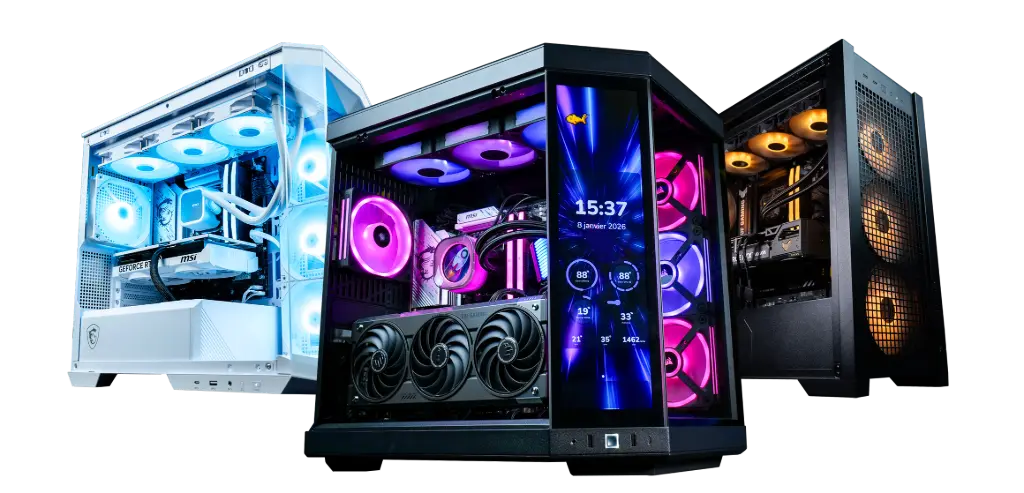
If you want to see FlowUP gaming PCs equipped with AMD GPUs already:
Why the RX 9070 XT and RX 9070 are making so much noise
If they’re making that much noise, it’s not just because they’re new. It’s mainly because AMD has managed to place two cards in a segment where players are primarily looking for the best value for money. Both the RX 9070 and the RX 9070 XT come with 16GB of GDDR6, whereas the amount of VRAM has become important in 2026, and they arrive with a RDNA 4 architecture that’s stronger in ray tracing and AI than the previous generation.
The real star is the RX 9070 XT in particular. Why? Because it delivers performance very close to more expensive NVIDIA cards, while still offering better value for gaming. Tom’s Guide, for example, says you’re looking at around 95% of the performance of a RTX 5070 Ti for about 80% of the price, and Tom’s Hardware describes it as one of the most balanced cards on the market for performance/value.
👉 If you want a guide to help you choose your GPU: What GPU to buy in 2026 despite price rises?
RX 9070 XT vs RX 9070: what are the real differences?
The logic is simple: the RX 9070 is the more sensible version, while the RX 9070 XT is the more powerful one. The 9070 keeps the essentials that make the range so appealing: 16GB of VRAM, 256-bit bus, 2x8-pin, DisplayPort 2.1a and HDMI 2.1b. The XT goes higher in clock speeds, includes more Compute Units, and uses a bit more power.
| Feature | RX 9070 | RX 9070 XT |
|---|---|---|
| Compute Units | 56 | 64 |
| Game clock | 2070 MHz | 2400 MHz |
| Boost clock | up to 2520 MHz | up to 2970 MHz |
| Raw power (FP32) | 36.1 TFLOPs | 48.7 TFLOPs |
| Power draw (TBP) | 220 W | 304 W |
| Recommended PSU | 650 W | 750 W |
VRAM | 16GB | 16GB |
So I’d recommend the RX 9070 if you want to stick to the spirit of the range, but with a slightly more reasonable power draw card, and the RX 9070 XT if you want to get the most out of value for money/performance.
👉 Can’t decide between 8GB, 12GB or 16GB of VRAM? : 8GB, 12GB or 16GB of VRAM: how much do you need in 2026?
Why the RX 9070 XT is probably the best for value for money
If you have to highlight one between the two, it’s clearly the RX 9070 XT. Not because the RX 9070 is bad—on the contrary—but because the XT has the strongest positive signals when it comes to tests and rankings.
Tom’s Hardware clearly says that the RX 9070 XT offers “strong mainstream performance at a great price”. In its 2026 ranking, the site also states that in 4K, the RX 9070 XT is the best among the cards able to hold 60 FPS average in their tests.
Tom’s Guide also recommends it as one of the best cards for gaming, explaining that it delivers performance close to the RTX 5070 Ti for a lower cost.
So yes, for gaming, the RX 9070 XT is today one of the hardest graphics cards to beat in terms of value for money.
What uses are the RX 9070 and RX 9070 XT perfect for?
AMD highlights Native 4K Ultra results for both cards based on over 30 games. On the product page, the RX 9070 XT is advertised as being on average 42% faster than the RX 7900 GRE, while the RX 9070 is 21% faster. Based on that, we can say these aren’t cards for budget 1080p, but rather GPUs aimed at 1440p and playable 4K.

So, to sum up: if you want to play in 1440p and/or 4K, with 16GB of VRAM—or if you’re on a budget and don’t want to spend too much on an NVIDIA—we recommend going for the RX 9070 or the RX 9070 XT.
Do you want a setup to play in 1440p with lots of FPS?
RX 9070 or RX 9070 XT: which one should you choose?
the RX 9070 if:
- You want to keep the 16GB and the feel of the range
- You want a card that uses less power (220 W, 650 W recommended)
- You want an AMD build
the RX 9070 XT if:
- You want the most high-performance version
- You want to get the best value for money
- You’re mainly targeting the 1440p or the 4K
- You’re okay with a card that uses a bit more power (304 W, 750 W recommended)
👉 If you want to know how to choose your gaming PC setup in 2026
And compared with Nvidia, what does that look like?
That’s where the value-for-money argument really makes sense. Tom’s Guide explains that the RX 9070 XT delivers about 95% of the performance of the RTX 5070 Ti for around 80% of the cost, while also pointing out that NVIDIA still has the edge when it comes to ray tracing and the DLSS ecosystem. Tom’s Hardware also says that in 4K, the RTX 5070 Ti has almost identical performance without upscaling, but that the RX 9070 XT remains the best value at this performance level.
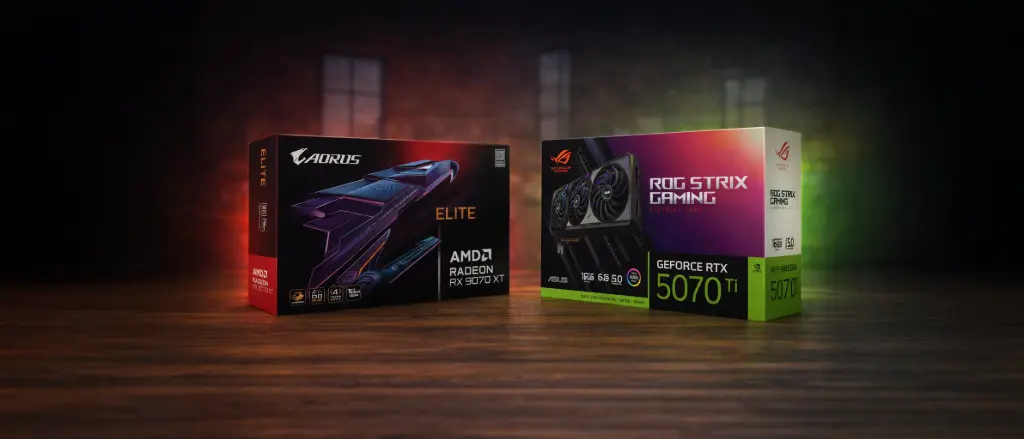
Do you want a card for gaming? With a good price-to-performance ratio? Lots of VRAM? Then AMD has a very strong argument with the RX 9070 / 9070 XT today. But if you want maximum ray tracing or the DLSS ecosystem, NVIDIA still has its own advantages.
👉 Also discover: the difference between NVIDIA and AMD in 2026
Conclusion: are the RX 9070 and RX 9070 XT worth it?
Yes, clearly. The verdict is simple: the RX 9070 XT is today one of the best graphics cards for value for money on the market for gaming, especially for accessible 1440p / 4K. The RX 9070 is a good alternative if you want to stick with this AMD logic, with 16GB of VRAM, a slightly more affordable card, and lower power consumption. Both cards have a very strong positioning because they combine 16GB of VRAM, real gaming performance, and an aggressively priced offer compared to the competition
At FlowUP, the idea remains simple: to offer coherent PC and AMD builds, assembled and tested, with components that actually make sense—not just impressive spec sheets.
FAQ RX 9070 XT / RX 9070
Is the RX 9070 XT a good graphics card in 2026?
Yes. Tom’s Hardware talks about a card that delivers strong performance at a very good price, and Tom’s Guide places it among the best cards around for gaming.
Is the RX 9070 XT better than the RX 9070?
Yes, it’s the more muscular version: 64 CU for the RX 9070 XT, versus 56 for the RX 9070, a 2970 MHz boost versus 2520 MHz, and 304 W versus 220 W, while keeping 16GB of GDDR6 on both models.
Is the RX 9070 XT the best graphics card for the price?
In the mid-to-high-end gaming segment, you can very clearly place it among the best options on the market. Tom’s Hardware positions the RX 9070 XT as the best balance of price/performance/efficiency for enthusiasts, and as the best value at 4K in its 2026 line-up.
How much VRAM do the RX 9070 XT and RX 9070 have?
Both cards, the RX 9070 and the RX 9070 XT, have 16GB of GDDR6, with a 256-bit bus and 64MB of Infinity Cache.
What power supply do you need for an RX 9070 XT or an RX 9070?
AMD recommends 750 W for the RX 9070 XT and 650 W for the RX 9070.
RX 9070 or RX 9070 XT: which one should you choose?
The RX 9070 XT if you want the best performance and the biggest gaming impact. The RX 9070 if you want to stick with the line’s spirit, with a more sensible power draw and potentially a better deal if the price gap becomes too large.
